Wednesday, December 19, 2012

Warming Up - Exercise 11

26 Acts of Goodness

Allison Wyatt, 6
I just read an article about NBC's Ann Curry's initiative to encourage everyone to commit to doing 26 Acts of Goodness, one for each of the children and adults who died in Newtown, CT. In her blog she said,

"I know the truth: if you do good, you feel good. It’s the most selfish thing you can do. Right now, this country wants to heal. I think the only thing comforting in the face of a tragedy like this is to do something good with it if you can. Be a part of that wave."

I'm in. I don't know that I want to start counting to keep track of whether I'm at #19 or even #27 - I just want to start doing something, and I don't want to stop.

Emilie Parker, 6
One other step I plan to take is to use the 26 Sandy Hook individuals as inspiration for the pieces I write when I begin my Project 365. My goal is to write at least 500 words each day to post here. I had always planned to write descriptions of people and places, to warm up to the idea of pulling them all together into short stories, essays, and maybe even something longer. I knew that I could use my own experiences, the people and places that have become part of my life as inspiration. But the photos of the Sandy Hook children are so amazing, evidence of the amazing lives that were cut short; these are the inspiration I will use instead. And I'll use their names so that I will never forget them.

Monday, December 17, 2012

Warming Up - Exercise 10


Blink! 

How long does it take to blink?  A second?  Half a second?  How much can you learn about someone in the blink of an eye?  These questions lead to some interesting concepts in Malcolm Gladwell’s best seller, Blink:  The Power of Thinking Without Thinking.

In his book, Gladwell presents a number of examples that initially seem counterintuitive, especially to Baby Boomers and bureaucrats.  We usually accept as a given that more data will make both the task of decision making easier and the results of the decision better.  Instead, Gladwell proposes that in many situations, when the decision maker is an expert, less is really better.

One example that I found compelling concerns determining the likelihood that a physician may be sued for malpractice.  Gladwell proposes two scenarios and asks which would provide the average person with the information needed to determine which doctor has been, or will be, sued.  In option one, the assessor would have information about the doctor’s training and credentials and records showing how many errors the doctor has made over the past years.  In option two, the assessor would be able to listen in on very brief snippets of conversation between each doctor and his or her patients.  Gladwell’s surprising assertion is that option two provides more relevant information.  You see, people don’t sue doctors just because they’ve been harmed by shoddy medical care.  People sue doctors because they’ve been harmed by shoddy medical care and something else happens to them.  People sue doctors when things go wrong – but they sue the doctor they believe didn’t care.  This is why there is more relevant information available in overheard conversations between doctors and their patients if the question to be answered is “Which doctor is more likely to be sued for malpractice.”

In fact, psychologist Nalini Ambady refined the experiment that proved Gladwell’s contention by taking ten second segments of these recorded conversations and “content-filtered” the slices so that there were no recognizable words left.  The only thing left was the intonation, rhythm, and pitch.  And using only that much information, she was able to predict which doctors got sued and which didn’t.

A “blink’s” worth of information, when presented to an expert, is enough to predict certain behaviors.  Gladwell provides many more such examples to support his theory that we can accurately process information even when it doesn’t seem as though we have had enough time to process any information.  Yet, we continue to look for more and more data on which to base decisions.  And we continue to propose more study, more research, and pilots from which we can gather even more data before we commit to making changes.

But Gladwell also points out the dangers of acting too quickly on the basis of first impressions.  He identifies the all-too-common mistake of making decisions on the basis of appearances as the “Warren Harding Error,” after the 29th President of the United States who served for just over two years.  Historians have often identified President Harding as one of the worst in U.S. history.  Warren Harding became president in 1921 at least in some part because to many people, he looked like a President.  

To explain the extent of the challenge we face overcoming the “Warren Harding Error,” Gladwell describes the Implicit Association Test or IAT.  The premise of the IAT is that we make connections more quickly between pairs of ideas that are already related in our minds than we do between pairs of ideas that are unfamiliar.  The website, Understanding Prejudice, explains that the IAT reveals unconscious biases regarding people of different races, genders, religions, or other characteristics.  And the unconscious bias that the IAT has been uncovering for the longest period of time is based on race.  To test out Gladwell’s theories, I completed the IAT for myself.  After all, Gladwell himself – the mixed race child of a white father and Jamaican mother – reported that his IAT results consistently rated him as having a “moderate automatic preference for whites.”

I tried my hand at two of the IATs available on the Project Implicit site.  And I can report that my results are consistent with Gladwell’s contentions.  This statement will be more meaningful later, so let me repeat it.  My results are consistent with Gladwell’s contentions.

You see, Gladwell contends that the “automatic preference” is unlikely to change over time.  I have taken two different IATs consistently over the past several days.  And the results of my taking the Race (i.e., Black-White) IAT, have been consistent – and consistently other than what I want the results to be.  The results over the past three weeks reveal that I have a “moderate” to “strong” automatic preference for whites.  This is not a result I want.  But since the IAT reveals “unconscious” associations, I shouldn’t be surprised by the consistency.  No one has to choose positive associations with the dominant group.  The fact that the associations are revealed should not, therefore, be surprising.

But on the other IAT – the Arab-Muslim IAT – my results have been quite the opposite:  The results on that IAT show “little to no automatic preference between Arab Muslims and Other People.”  In fact, once the result even showed “a slight automatic preference for Arab Muslims compared to Other People.”

How can I claim that my results – which appear contradictory themselves – are consistent with Gladwell’s contentions, especially since he proposes two apparently contradictory notions?  His first contention is that we don’t need to spend so much time gathering and analyzing data to make accurate decisions.  His second contention is that we need to avoid making decisions on the basis of only first impressions.  

But Gladwell also provides some interesting – and optimistic – ideas for how to take advantage of his arguments behind each of these two ideas.  You see, he learned that there is one way to change the IAT results.  And that one way probably explains why the results of my Arab-Muslim IAT show such a positive stance.

Gladwell reports that a student of one of Project Implicit’s three Principle Investigators has taken the Race IAT every day.  And every day the results were the same, until one day when his results reported a positive association with blacks.  This result was so puzzling that the student spent a lot of time trying to figure out what was different that morning.  Finally, he realized that he had spent the morning watching the Olympics, and in the space of those several hours, he saw some of the most powerful black athletes in the world.  His mind was full of positive associations with powerful black athletes, which translated into more positive unconscious associations with blacks generally.

The way to change the IAT results is to become accustomed to people in the other category.  Even more than that, to become involved with people in the other category in a manner that increases the positive thoughts you have about the other category.

And this is why I believe my results when taking the Arab-Muslim IAT are so different from the results of my taking the Race IAT – I spent the majority of my career with the Department of State in the Arab world where I have met some of the most passionate and compassionate people in the world.  But my attitude wasn’t always so positive.  I am ashamed to admit that I recall the days when my automatic response in a word association exercise to “Palestinian” would have been “terrorist.”  The connections between “Arab” or “Muslim” or “Palestinian” and negative images were in the newspapers, on TV, in the movies every single day.

Our first impressions are the result of two things:  our experiences and our environment.  By changing the environment, thereby changing our experiences, we can change our unconscious impressions.  Dr. Norman Vincent Peale said it in other words way back in 1952 in the title of his most widely read book, The Power of Positive Thinking.  

This is why I think the message of Blink! is so important.  By getting involved with the diversity around us, we can change our implicit associations.  We can change our unconscious first impressions.  We can do it.  And we must.

Sunday, December 16, 2012

Warming Up - Exercise 9

I’m from Minnesota

My name is Sandra, and I come from Minnesota.  I think that is the simplest way to begin my story because I’ve lived in enough different places to know that places become significant characters in my life. 

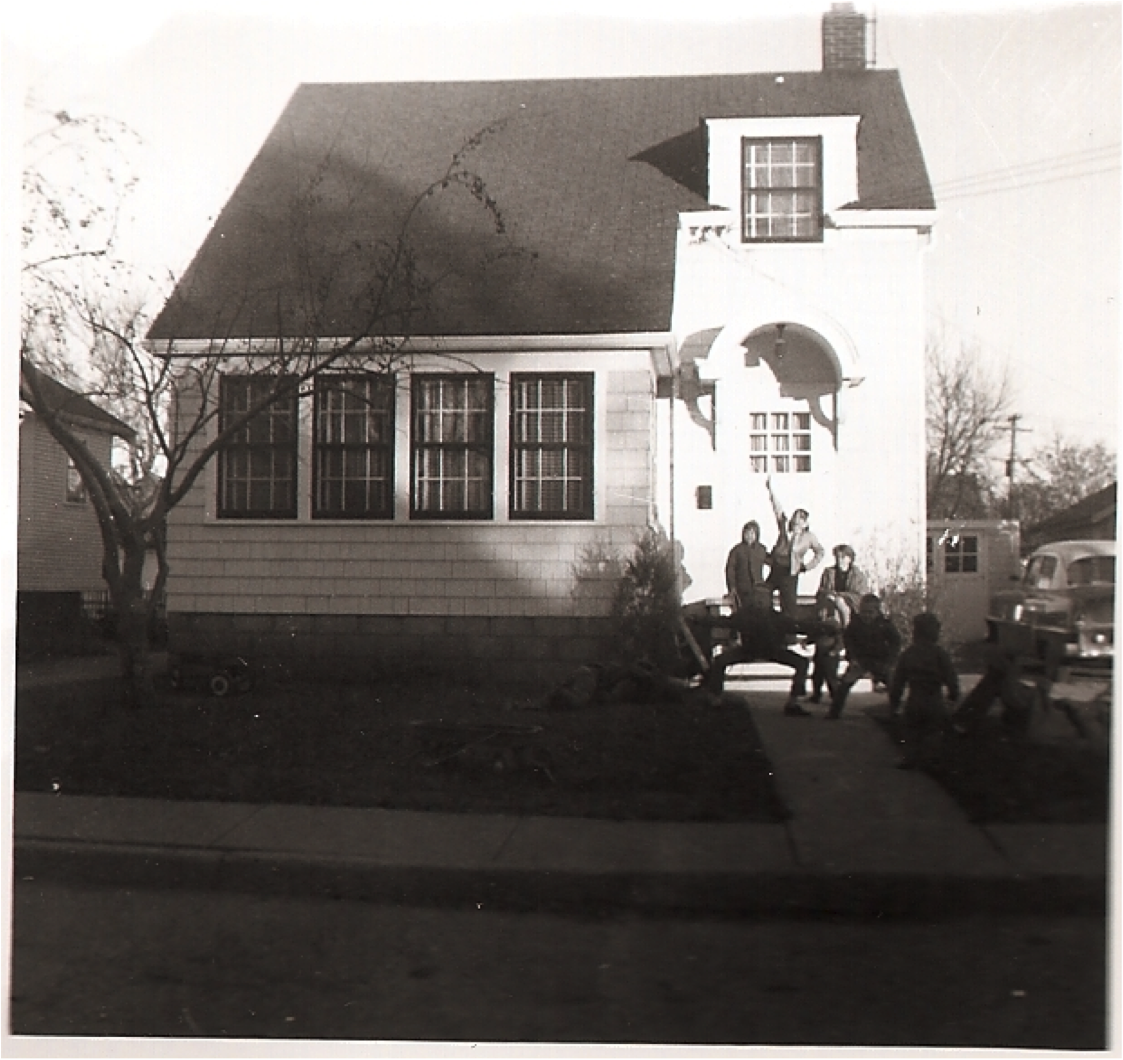
One of my most important places in my life is Dudrey Court, a two-block long street, spanning 3rd to 5thAvenue South, in my hometown.  It was at the time one of only two streets in town with a name instead of being numbered.  

But though Dudrey Court was short in length, and therefore small in stature, it played an enormous part in my life.

You see, people who live on Dudrey Court don’t really ever move away.  Take my family, for example.  My parent's first house was 307 Dudrey Court, a two-bedroom bungalow.  My parents had always planned to have five children, and Dad turned the bungalow into a three-bedroom story-and-a-half by converting the unfinished attic into a third bedroom when there were four of us.  That meant Mom and Dad had a bedroom, the two boys had a bedroom and we two girls had a bedroom.  And once the planned fifth baby got too big to remain in a crib in my parent’s room, they planned to put bunk beds into one of the rooms to accommodate the third boy or girl.  But my parents’ plan to have five children collided with the reality of my two youngest brothers arriving a month early as unexpected twins.

Twins complicate things.  My parents realized neither bedroom was big enough for four children.  And there wasn’t enough room on the small lot to expand the house.  In fact, none of the houses on Dudrey Court in those days had more than three bedrooms, but the houses on the east side sat on bigger lots.  So when the family in 312 Dudrey Court put their house on the market, my dad bought it, knowing he could add bedrooms at the back of the house.  And “voila.”  Our previous “across-the-street” neighbors, the Simonitsches, became our new “next-door” neighbors.  And our former “next-door” neighbors, the Colemans, became our new “across-the-street” neighbors. 

Since then, three other families have moved from small to larger houses on the street, or vice versa, as family sizes increased or decreased.  And families in those days, in that place, generally did increase.  The Simonitsches had eight children, spaced so that there was one of them corresponding in age to each of our six kids.  Margaret was my age -- and therefore my best friend.  The Colemans had four children, including twins a year older than my twin brothers; their oldest, Steve, was the same age as my brother Wayne, making it a virtually certainty that they would become best friends. 

Because Dudrey Court was so short, it wasn’t on the route to get anywhere.  As a result, it was a safe playground.  We played our version of baseball in the street. When we played kick-the-can or hide-and-go-seek, we set the goal in the middle of the street.  One of Mr. Carlson’s driveways had enough of a slope on it that we used it to launch ourselves on skates into the street.  So long as we stayed away from the avenues, we were safe. Perhaps because the street was our playground, we were referred to by outsiders as “the Dudrey Court Gang.”

Occasionally a family had to move from the neighborhood.  Our next-door neighbors, the Simonitsches, moved to Wisconsin Dells when Mr. Simonitsch changed jobs. Their oldest daughter, Margaret, had completed her freshman year of college in town, so the family agreed she would remain in the finished basement apartment of the house to complete college.  They rented the rest of the house to a young couple. Margaret asked me if I would like to share the apartment, rent-free, as she wasn’t sure she wanted to live entirely on her own after having been surrounded by so many siblings. But even though my parents could have kept nearly as close a watch on my activities by just looking out the dining room window into the basement window next door, they wouldn’t allow it! I have often thought that my apparent wanderlust may have started then – as a way to get even with my parents for not allowing me to move out of their house.

In August 1969, I finally did move away from Dudrey Court – at least I moved away physically. But when Margaret Simonitsch’s mother Mary passed away in a small town in Wisconsin a few years ago, the Dudrey Court gang reunited online, in spirit, as we mourned together the passing of one of Dudrey Court’s matriarchs, even though more than forty years had passed since she moved from the neighborhood. Then when my brother Brian died, the Dudrey Court gang reunited at his funeral in person. And this summer, many of us gathered for a picnic - just for the pleasure of seeing one another.

Dudrey Court is still a character in my life.  It always will be.

Saturday, December 15, 2012

Warming Up - Exercise 8

Windfalls:  Watch Out! 

Have you ever bought a lottery ticket?  Or been tempted when the prize amount soared into the hundreds of millions?  More importantly, have you ever won big?  Well, I have. But I’ve never bought a lottery ticket.  And those two statements go together to explain my title:  Windfalls:  Watch Out!

You see; I once won a lot of money – oh, not millions.  Just two thousand, two hundred, and nineteen dollars.  Not millions, but in November of 1972, it meant just about as much to me.  It was my windfall and it made the difference between my desire to go to graduate school and the means for me to do so.

Two thousand, two hundred, and nineteen dollars in 1972 was enough for me to pay the in-state fees and six months of living expenses so I could enroll at San Francisco State University.  That led to a degree, and a job overseas, which brought me into contact with the diplomatic corps, eventually leading to my entry into the Department of State as a Foreign Service Officer.  Sounds like a good ending, right?  Well, let’s go back to the beginning.

In November of 1972, I was working in Berkeley, California, earning $500 per month.  My rent was $125 a month.  My car payment was $80 a month.  My student loan payments were $100 a month.  After taxes, there wasn’t much left for anything else.  But I wanted to go to graduate school.  In fact, I had already applied and been accepted.  But I didn’t know how I was going to pay for it.  And then, one day, I got up late, late enough that I hadn’t left for work yet when the Channel 7 producer of Pippa Scott’s morning TV program called to ask if I would be willing to play their “name that tune” game.   

My telephone number was selected from the telephone book.  I had 5 minutes between the call from the producer to the second call with Pippa herself, just long enough to find the issue of the San Francisco Chronicle from the previous week with a column by Herb Kaen, my favorite columnist, that I recalled contained a clue to the answer.

I didn’t even have a television set.  So I had to listen to the tinny tune through the telephone receiver.  In response to Pippa’s question of whether I could name that tune, I responded somewhat hesitatingly, “I understand it is the theme from the movie ‘They Call Me Mr. Tibbs.’” I thought that was a clue.

Imagine my surprise when Pippa told me I was right.  So instead of the consolation prize of dinner for two in a restaurant in San Francisco, she told me I would receive a check for $2,219 on her program the next morning.

So I’m thinking that you’re thinking that all of this is still good news, right?  What’s the deal with my warning to watch out for windfalls?

The next day, I received a phone call from a friend to ask me if I was the Sandy Ferguson from Berkeley who won the money.  I said yes and asked how she knew.  She read it in Herb Kaen’s column that morning.  It seems that the producer contacted Herb Kaen to let him know that someone finally won the contest after reading his column.  So now my name is in Herb Kaen’s column.  Things are getting even better, right?  Let’s continue.

A few minutes later, the phone rang again.  This time it was a stranger who begged me to share my winnings with her.  Since my name and telephone number were in the telephone book – how else could Pippa’s producer find it? – anyone in the San Francisco Bay area could also find it.  And they did.

But what really scared me was the effect that winning the money had on my own thought process.  As I mentioned, it was enough money to allow me to enroll in graduate school.  But I didn’t do anything with the intent of getting that money.  It was entirely coincidental.  Coincidental that my number was selected from the book that day.  Coincidental that I got up late so that I hadn’t yet left for work that day.  Since I hadn’t done anything with the intent of obtaining the money, I began to think of spending it on something I had never planned to do – like taking a cruise.  When I think how I nearly wasted my windfall on something frivolous, I shudder.

After I had the check in my hands, I started looking around and my eyes fell on my 4-year-old baby blue VW bug.  It was nearly paid off, and that meant that it was getting more expensive to maintain.  I thought about getting a new car.  Now, it’s not that I thought about using my windfall to buy a new car.  My mind didn’t work that way any more.  Oh no, the first thought that crossed my mind was, “Well, I’ll just win some more money.”  That’s when it hit me.  My windfall winning had twisted my thinking.  It happened once, so why shouldn’t I expect it to happen again?

Imagine how much stronger the connection in my brain would have been if I had done something – like purchasing a lottery ticket – to win the money.

To explore my concern, I checked out the Gamblers Anonymous website.  It lists 20 questions to help determine if someone has a compulsive gambling habit.  Seven yeses mean you’re in trouble.  Fortunately, only two questions applied to me:

1. Were you reluctant to use "gambling money" for normal expenditures? 
2. After a win, did you have a strong urge to return and win more? 

So here’s the lesson I learned and my message for you:  Don’t waste money on lottery tickets.  If you buy a ticket and you don’t win, the money is gone.  But if you do win, you may just have “won” something you’d rather not have.

Next time you feel tempted to buy a lottery ticket, call me.  I have a list of a hundred good charities that can put the cost of that ticket to much better use.

Friday, December 14, 2012

Warming Up - Exercise 7


Rituals – Why We Need Them


Do we really have to put up a Christmas tree this year?  We won’t even be home to enjoy it.

I’ve heard this thought a couple of times.  I’ve even said it myself.  In fact, the version I spoke was more a statement than a question.  My then-husband and I planned to spend the Christmas holiday with my family in northern Minnesota.  Being ever so practical, I told my husband that it didn’t make any sense to put up a tree that year.  And since I had already come to that very sensible conclusion, there wasn’t much room for my husband to provide his counter arguments.  We didn’t put up a tree that year.

It wasn’t until after the holiday that he told me he felt cheated that year.  We spent the holidays with my Scandinavian family where we ate buttered lefse sprinkled with sugar on Christmas Eve, Christmas Day, and every other day spent at my parents’ home, but there was nothing of his Romanian traditions – no whiskey shots before each meal, no Romanian carols.  There was nothing that meant Christmas to him.  Once I realized how important the elements of tradition – the ritual of the holiday – were to him, I also realized that by not putting up a tree, I robbed both of us of an opportunity to establish some of our own uniquely Scandinavian/American-Romanian/Canadian traditions. 

Since my practical nature is likely due in large measure to the influence of my practical parents, I wasn’t surprised one Thanksgiving to hear my father say he didn’t think it was necessary for him to put up a Christmas tree that year.  It was the first Christmas after my mother’s passing the previous January.  Her death came just days after the previous year’s Christmas tree had been taken down and stored away.  I had already decided that we kids would put up the tree, lights and decorations for my father before I returned to Washington.  And that we did – most of the decorations were placed by me – Dad’s oldest child – and three-year-old Megan – Dad’s youngest grandchild.

The next year, I traveled back to Minnesota again for Christmas.  This time, my husband traveled with me.  And our son traveled to England to spend the holidays with his English relatives.  So again, I wasn’t surprised when my very practical husband pointed out that he didn’t think we needed to put up the tree that year since no one would be home on Christmas anyway.  He was a little surprised to hear me laugh so loudly in response to the idea – I couldn’t help but think of the contrast to the time so many years ago when I first said the same thing.  It felt good to know that my husband and I share that practical streak.  But since our family consists of three, I advised him that we need to know how our son would feel about skipping the tradition.  Our son’s response was that well, yes, it wasn’t necessary for us to put up the tree, especially since he’ll be gone for two weeks and we’ll be gone for eight days.  But he added that it wouldn’t be Christmas without a tree, even if was no one would be at home.


We put up the tree that week.

Thursday, December 13, 2012

Warming Up - Exercise 6


To Visit Japan, A Childhood Dream

One of my earliest childhood memories is of a wooden trunk in the basement that contained my parents' mementos.  The trunk was off limits to us kids, although occasionally Mom or Dad would open it while we were in the basement and would show us some of the things in it.

My special memories of the contents of that trunk were all connected to items my father brought back from ports he visited during his days in the Merchant Marines during and in the year after World War II.  And the most important of those for me were a  kimono and fan from Japan.  I had never seen such a colorful, decorative, or soft piece of clothing as that kimono.  And it opened up a door in my curiosity that demanded I learn as much as possible about Japan and the people who lived there.

When I started school, I discovered there were a few books in the school library about Japan.  I read them all, starting with the shelves that were identified as appropriate for first graders and then continuing up the graded shelves.  By the third grade, I had finished all the available books, all the way up through those on the sixth grade shelf.

The dream of someone else also contributed to my dream.  Miss Ingram, the music teacher in our elementary school, was dedicated to igniting interest in music among her students.  Each year she organized two musical productions, operettas, in which we students starred, one for the third and fourth graders and one for the fifth and sixth graders.  The sixth grade production when I reached that age had Around the World in 60 Minutes as its theme. One piece included was the Gilbert and Sullivan tune "Three Little Girls From School Are We."  I will never forget wearing the purple silk kimono from the basement trunk in that production.  And my curiosity about Japan got a little more of a boost when Miss Ingram taught the three of us who sang the song how to open our fans one-handed with the flick of the wrist.  Until then, I had had to use both hands to pull the two wooden ends apart carefully to expose the painted scene of Japan on the delicately folded paper between the wooden handles.  By then, my dream had grown from learning as much as possible about Japan to visiting Japan.

In the following ten years, my Japan dream took a back seat to the shorter-term goals of finding and keeping best friends, passing tests, getting good grades, growing up, getting boys to notice me, getting my parents to stop noticing everything I did, and getting away from their limits and the small town I had felt I was stuck in.  Eventually I did made it away from the midwest, all the way to San Francisco where I ended up in a Masters Degree program in Teaching English as a Second Language (ESL).  My acceptance into that program was the switch that turned my dream of visiting Japan back on.

There weren't many jobs in Japan when I completed my training, so I chose Iran as my first overseas experience.  While there, I continued to dream of visiting Japan.  At the end of that two-and-a-half year-experience, I finally made it to Japan, my final stop in a two-week, multi-country trip home.  Four days in India, then four in Thailand, four in Indonesia, a day back in Thailand, and finally, four days in Tokyo.  Four days when my jaw ached the whole time because of the ear-to-ear grin that I couldn't stop.  I was in Japan!  And I loved everything I saw.

By accomplishing my dream, I learned that having a dream, and working steadily to accomplish it, made problems and disappointments, both small and large, almost disappear.

The Big Lesson

The most important lesson of this experience wasn't obvious to me until years later when my parents, my husband, and I were crossing the mall in Washington, DC.  A middle-aged Japanese man approached my father to ask for directions.  After pointing out the way, my father joined us and commented that fifty years earlier, while he was in the Pacific in the Merchant Marines, he would never have imagined that he would one day be speaking to someone from Japan in the capital of our country.

Hearing that comment made me realize how much it meant that my parents never discouraged me from my dream of going to Japan, a dream that began so shortly after the end of World War II.  It would have been easy to understand had either of my parents tried to dissuade me from my interest in our former enemy.  Instead, they encouraged the spark of interest with the hope that it would lead to other interests and a love for learning. They were right.

Wednesday, December 12, 2012

Warming Up - Exercise 5

THE PHYSICS OF TOOTHPASTE TUBES AND SOAP BARS

My parents didn't disagree about how to squeeze the toothpaste tube.  They agreed that the only reasonable place to squeeze it was at the bottom, not at the top, and not in the middle.  And they spent a lot of time trying to get that message through to us kids.  These were the days before toothpaste pumps and plastic tubes.  These were the days when toothpaste tubes were made from tin and came with painted labels that flaked off as we rolled the tubes up.

There was one brand that would
have solved the problem very well:  Vademacum, a pink, powdery, not quite minty toothpaste made in Sweden that came with its own roll-up key that fit on the bottom of the tube.  But our family was Norwegian, not Swedish.  And while nearly everyone in Minnesota in those days came from Scandinavian stock, there were differences, such as the difference between being Norwegian and being Swedish.  I never knew if the fact that Vademacum came from Sweden was the reason we didn't use it, or if it was more expensive the other brands, or if Mom and Dad just didn't like the taste.  Whatever the reason, instead of picking a technical solution, Mom and Dad kept trying a pedagogical approach:  whenever they found evidence that small fingers had made an impact in the wrong place, they reminded us of the importance of squeezing from the bottom.

At about the same time, I was going through a particularly intense curiosity phase.  I had at least two siblings by then, maybe even three.  No matter the number, what was important was that the youngest one was an infant.  And I was old enough to "get" to help Mom with the daily bathing ritual.  Sometimes I even got to help change the diapers.  In those days, changing diapers meant forcing thick diaper pins with pastel-colored plastic heads through multiple layers of thick cotton, without poking the baby in the process, right after having removed the pins from multiple layers of soggy thick cotton.  The points of those pins were sharp enough to cause the baby to scream, but not sharp enough to get through the layers of cotton without some force, or some help.

The help came in the form of something that these days might be found in "Hints from Heloise."  I watched Mom push the diaper pins into a bar of soap that served as a diaper pin cushion.  The soap added just enough slick to the metal so the pins just slid through the diapers.  Using the bar of soap probably aided in the disinfecting of the pins once removed from the soggy diapers, too.

But what was more amazing to me was that just by washing my hands with the bar of soap, the tiny holes in the soap bars disappeared.

And that  observation made me wonder if I could work the same trick with other materials.  I was somewhere between 5 and 7 so I hadn't been exposed to science classes that might have provided me with an understanding of the principles that explain the differences between the properties of solids, liquids, and gases.  And I probably wouldn't have understood just which of those categories bar soap falls into anyway.

Since the soap pin cushion usually sat in the bathroom, on the edge of the tub, right next to the diaper pail, my eyes fell on items close to it for my experiments.  And the first thing I put my hands on was the toothpaste tube.  I pushed a pin into it in a couple of places and held the tube under running water and swished my hands around it a few times.  Then I looked to see if the holes disappeared.  I don't remember if I could see the holes or not because when I brushed my teeth, any observations I had earlier were replaced by the vision of tiny streams of toothpaste coming out of the holes I had created.

And while neither Mom nor Dad had ever told me I shouldn't push pins into toothpaste tubes, I knew I couldn't admit to them or anyone else that I had done that.

Later that day, Mom and Dad came to my younger brother and me and showed us what happened when they squeezed the toothpaste tube.  I am quite certain the lack of surprise on my face gave away my role in this event, but my parents didn't accuse either of us or express anger or disappointment or any of the other negative responses I had expected.  Instead, they pointed out that the phenomenon they were demonstrating was probably the result of us kids squeezing the tube from the top instead of from the bottom.

The result:  I have never since squeezed a toothpaste tube anywhere but from the bottom. 

The Lesson

Wise parents don't take every opportunity to point out how much smarter they are than their children.

Sometimes cutting a child some slack gets better resuts than catching the child doing something against "the rules" and passing out punishment.

How I Have Used This Lesson In Life

Just as it was more effective for my parents to use the experience to make a point they had not succeeded in making by other means, sometimes it is more effective for a supervisor to praise an employee, or a teacher to praise a student, for doing something right, even if it isn't clear the employee or student was involved in the accomplishment.  The result may be a turnaround in the employee's or student's motivation.