Tuesday, January 21, 2014

Day 355 - Nasser's Plans

Highly motivated and experienced secondary level teacher seeks opportunity to obtain PhD in curriculum development for visually impaired students in inclusion programs with goal of establishing a computer training center for the blind in Eritrea to improve educational, vocational, and professional opportunities in the increasingly technically advanced world.
Nasser
Nasser
That is the lead paragraph in Nasser's resume - to introduce himself to those he hoped would help make his dream come true. He had succeeded in getting his Masters Degree in Curriculum Development for Special Needs, a necessary step in his long-term dream of establishing a program that would provide Eritrean children who were deaf, blind, and disabled in other ways with a solid education. He was dedicated to the idea of providing an education to all children in the same classroom, not segregating children based on their physical challenges. As a teacher, his classes were all inclusive, his term for mainstreamed. As a student, he had experienced both and he preferred inclusion.

Before I left Asmara, he asked if he could contact me for help in the future. I agreed. He had already impressed me with his determination. He had impressed the boys who agreed that I should communicate with them through Nasser. And he had impressed several people at the U.S. embassy who tried to help him as they could.

Nasser was able to meet with Melissa, the Community Liaison Office Coordinator at the embassy, to discuss possible ways to ensure support would continue for the boys. Nasser reported that the boys were able to get their team registered with the Denden Secondary School program. So long as Melissa was still in Asmara, she was my liaison with Nasser and the boys as I sent them books on soccer as well as simple English. That may not have been the best choice on my part, however, given the tension between the Eritrean government and ours. At one point not long after I left, Habtom, the team's coach, complained to the organizers of the Denden program that Nasser was keeping for himself what I had sent to help the team. Before they left, one of the team of inspectors who had been in Asmara for three weeks gave me an envelope with his spare nakfa and asked that I give it to the boys. I had a few other small items that I didn't think I could bring back to the U.S., such as a bracelet made from zebu horn, and Melissa gave those things for me to Nasser. In addition, I sent Nasser money through Western Union for his family. In order to clarify Habtom's complaint, Nasser had to provide a list of everything he received from Melissa - the nakfa, the bracelet, the books, and some DVDs on soccer - to the organizers. The result was that anything Melissa had for Nasser had to be turned over to this organizing group instead of being handed directly to Nasser. Not surprisingly, the team decided they needed a different coach.

I had expected to be in Nigeria for the three years after I left Eritrea and that offered the promise of my being able to get back to Eritrea now and then. But when the assignment to Nigeria was canceled, it was clear I would not get back to Eritrea. My attention then turned more toward providing support to Nasser and his family. One reason I was willing to provide him with support was that I learned so much from him. The other is that his requests were never for handouts. When he requested help, it was for a specific plan that he hoped would get his family into a better situation financially.

Tekelu and Nasser's children
The most important lesson I learned from Nasser is that sometimes it is better to ask for help than to continue trying to get something done on my own. Nasser had - and still has - big dreams. He knows that his dreams are more likely to come true if he is not the only person working on them. And I have learned through him that sometimes I could have gotten more done more quickly and better if I had just taken the time to ask for help.

An equally important lesson was the one he lived by never letting disappointments define him. When one approach failed to produce the result he hoped for, he took another approach. This was a lesson that I should have considered more when my plans to travel to Nigeria ended. I didn't bounce back quite the way I always saw Nasser do. I had to go through a short woe-is-me phase as I tried to figure out how to recover from the loss of what had been such a promising opportunity. But I hadn't known Nasser long enough to have seen that side of him then.

The first time Nasser asked for help, it was so he could buy goats for Tekelu and the other children to take care of. The family would get the milk to make cheese from the goats and eventually they would have the meat to eat. They bought the goats, but instead of having the children take care of them, Nasser and the children brought the goats to Nasser's family who lived outside of Asmara for them to take care of the animals. Months later, Nasser reported that the animals were doing what animals do - reproducing - so his family was able to bring one back now and then to get fresh milk and meat for holidays.

Next Nasser asked if I could send money so that Tekelu could buy items to resell to earn money for school supplies. I'm not sure how well that idea worked, but it was a plan, not just a request for money.

For the next three years, I continued to hear from Nasser by e-mail. He continued looking for ways to implement his dream and I did what I could to try to find an appropriate university program in the United States for him to explore possibilities. I even attended an open day at Catholic University in Washington, DC, on his behalf to learn more about their program. It was a struggle to get people to understand that a blind man wanted to obtain a degree specializing in teaching others with special needs. Programs seemed geared towards providing assistance to students with special needs to compete in other programs or for students without special needs to compete in programs designed to address special needs. But I continued to do research for him and to contact people to explain his goals. Perhaps Nasser put too much faith in me. But no matter what I did or couldn't do on his behalf, he never gave up on me, on himself, or on the future.

So maybe my calling to Africa was really for Nasser.


Monday, January 20, 2014

Day 354 - A Quick Trip to Yemen

Samira and Sumayya, two women at the Sanaa embassy
Since Eritrea is so close to Yemen, I took the opportunity to fly to Yemen for a long weekend before I left Africa. I was looking forward to seeing the places I had enjoyed so much and especially to see the people.

One of my Arabic teachers at the Foreign Service Institute is married to Tim, an American who had joined the Foreign Service the year after I returned from Yemen. They had met when Nisreen was his teacher with the military before she joined State. Since they were both Arabic speakers, there was no doubt that they would be going to the middle east for Tim's first assignment. Since Nisreen is originally from Iraq and still has family there, that was the only middle eastern country Tim knew he wouldn't be sent to. In the end, he was assigned to Yemen. Tim and Nisreen offered me a place to stay while I re-explored Yemen.

One of the people I was hoping to see was Sumayya, my assistant for most of the time I was in Sanaa. Sumayya's parents were determined that she should marry. They had arranged her engagement before I arrived in Yemen, but by the time I arrived, she had broken it off, insisting to her parents that she was not yet ready to get married.  Then toward the end of my year in Sanaa, they pressured her again, saying that they wanted her to stop working as they felt her involvement with the embassy was distracting her from focusing on getting married. We had a party for her on her last day in the office, but as she was leaving she told me not to worry because she had no plans to get married and she was certain she would make her parents regret that they had forced her to quit her job. She planned to be back at the embassy in a short time.

Sandra and Sumayya at Sumayya's farewell party
Sumayya was just one of many Yemeni women who countered the stereotypical image of women in the middle east. While she, Samira the Human Resources Assistant, and the other strong Yemeni women I met wore the traditional clothing and behaved modestly, as society expected from them, they were not weak-willed and did not do what others wanted just because they were told to. Sumayya wanted a future for herself, a future where she knew she could support herself. This may have been even more important in her case than for the other women I met because she was the youngest of the children in her family. Even in the west her parents would have been considered elderly.

After she stopped working at the embassy, I continued to see Sumayya as she and others invited me to join them in their homes where they could relax and not have to be constrained by abayas and hijab coverings. One of the most interesting women I met through Sumayya was originally from Aden. I didn't get to know her well, but I was struck by the fact that when her mother called her, the two of them spoke together in English, not Arabic. From 1937 until 1963, Aden and the immediate surroundings were a British Crown Colony. Even before 1937, Aden was under British rule, but administered as part of British India. The British presence ended in 1967 when the Federation of South Arabia became the People's Republic of South Yemen. In spite of the fact that 35 years had passed since the British left Aden, its influence was still evident.

Sumayya got in touch with me as soon as I arrived in Sanaa. Since it was very rare for Yemeni women to drive, Sumayya had arranged for a car and driver to take us out of Sanaa, to the village of Thula, where the young children seem to speak all the languages spoken by tourists who arrive there. I had been there several times during my year in Sanaa. What was on offer at the Thula souq was no more interesting than what was on offer in Sanaa, but just watching the children as they interacted with visitors was worth a return trip. In many cases, the shops themselves seemed to be totally in the care of the children. The boys in particular learned quickly how to strike a good bargain.

At the time of my quick trip to Yemen, Thula was out-of-bounds for embassy staff, but Sumayya was certain she and I would have no problem getting around, especially since we had a male driver with us. And I knew I had my guardian angel, so we headed out for the adventure. I couldn't just look without succumbing to at least one purchase.  After negotiating and then rejecting the best price on several items, I ended buying a bundled string of extremely small beads the seller said were coral. He also assured me I would not see anything like it in any of the shops in Sanaa. He was right. The coral beads were actually clay, worth much less than that best price I settled on.

Typical wall of jewelry in the Sanaa souq
I also made a trip into the Sanaa souq where one of the dealers I spent much time talking with during my year in Yemen, Mohammed, asked me if I was still dancing with my car. He insisted that I come home with him for lunch so that I could meet his wife. I did meet her, but only through the crack in the door leading to the kitchen because Mohammed had invited a few other of his friends, all men, for lunch as well.  Lunch was delicious. The conversation was all in Arabic, so I spent my time listening, trying to figure out something of the topic. And afterwards, Mohammed and I returned to the souq where I made the rounds to all the shops I had frequented before, picking up a few trinkets here and there, to be polite, not because I needed anything.

Nisreen invited many of the staff of the embassy for a party after work on the Friday. I still feel guilty for all the work she put into that evening, with nowhere near the help she should have gotten from her guest. Many of the people who came were interested to meet me since they couldn't imagine that there was a person on earth who would choose to come back to Yemen after having gotten out. Life in Sanaa was much more constrained than it had been when I was there.

And since then, life has become even more constrained. All the staff now live in a hotel near the embassy compound. They are driven to and from work in embassy vehicles. There is no more exploring the streets, varying the route on whim or caprice or dancing with cars on the roads.

I am so very glad I had the opportunity to spend a year in Yemen in what were clearly the good old days.


Sunday, January 19, 2014

Day 353 - Train Ride

Train ride from Asmara
Stepping back to the beginning of my stay in Asmara for a moment, I had one adventure that was more significant than I understood in the beginning. I rode from Asmara to the furthest point on the way to the coastal city of Massawa that was possible at that time on the Eritrean Railway. The railway had been damaged during World War II and then partially dismantled after the civil war. The original engines were all steam locomotives, complete with the smell and soot of the burning coal that provided the energy to create the steam.  The engine on our trip looked far more modern and may have been one of the more recently acquired diesel locomotives. The trip was to celebrate that the tracks had been relaid to an intermediate point between Asmara and Massawa.

Boys on the train
Boys on the train
That train trip was a history lesson and an introduction into the sociology of the country.

Its newest equipment is more than 50 years old, with most of the equipment dating back before World War II and many of the engines built in the 1930s. The seats were wooden benches, not built for comfort. The tracks took us around the side of mountains and through tunnels. Most of the passengers were along just for the celebration. I recall that we had a short stop at the end point, but I don't recall there being anything to see. Along the way, a few brave men dared to jump onto the platform at the back of the slowly moving train to shorten the time they otherwise would have had to spend walking beside the track. Whether there was sufficient demand to put the train into regular service between Asmara and the intermediate point seemed unlikely to me. The real goal was to complete the tracks to Massawa so that goods could once again be brought into the country through the Red Sea.

View from the train
View from the train
The railway was built in the 1930s by the Italians to connect Asmara and Massawa, the two major cities of what was then Italian Eritrea, a colony of Italy since 1882. The train is narrow gauge, the standard in Italy at the time. Italian Eritrea was roughly within the same boundaries as the current country of Eritrea, although the Italians enlarged it by granting a portion of northern Ethiopia to Eritrea in response to the assistance of Eritrean Ascari, the colonial Eritrean military, against the Ethiopians as Italy sought to expand its colonial reach. Italian Eritrea was ruled from 1882 by the Kingdom of Italy and then later by the Italian Fascists who in 1936 consolidated Italian Eritrea, Italian Somaliland, and the recently defeated Ethiopia into Africa Orientale Italiana or Italian East Africa. The Italians made Asmara the industrial center of Italian East Africa which increased the flow of Italians into Eritrea that began at the beginning of the 20th century. The Italians came to Eritrea to set up businesses and factories. The impact of the Italians in Eritrea can still be seen everywhere in Asmara in the architecture of the buildings lining the broad boulevards in the center of the city as well as the many Italian restaurants and pizzerias in the city. The best pizza I have ever had was in one of the many pizzerias in Asmara.

When the Fascists under Mussolini came to power in 1922, the colonies were ruled harshly with stress on the political ideology of colonialism. The Italians used Eritrea as a base for attacks on Ethiopia in the 1930s and on Sudan during World War II. Serving in the Eritrean Ascari was one of the few paid employment opportunities for Eritrean men.

Fiat Tagliero garage and service station in Asmara, http://creativecommons.org/licenses/by/2.0/deed.en
Fiat Tagliero garage and service station in Asmara
At one time, there were more Italians living in Asmara than there were native Eritreans. The city was essentially one of the first planned cities, designed and built for the Italians, not for the Eritreans. It still has a large collection of Italian art deco era buildings including a Fiat garage and service station that was built to resemble an airplane.

At the end of World War II, the Italians were forced to cede their claim on Italian East Africa and the British took over administration of Eritrea, continuing to maintain it as a separate administrative entity from Ethiopia. But as opposition to British colonial rule grew, so did the Ethiopian determination to absorb Eritrea. In 1952, they did.

More Italian architecture
Understanding the relationships among the Italians, the Eritreans, and the Ethiopians may have made some of what I saw in Eritrea less surprising. In spite of the fact that the Italians ruled Eritrea for more than 60 years, that same time period was one of separation from Ethiopia, of having access to the sea, of being the industrial center of the larger Italian colony, of being selected by the Italians to base their military. It is easy to understand that the Eritreans did not want to be part of Ethiopia. It is also easy to understand how the Ethiopians would resent Eritreans having those advantages. It is even easy to understand the border disputes that still continue since areas that had been part of Ethiopia were given to Eritrea by the Italians, making the border claims muddy, not clean lines. Without Eritrea, Ethiopia is landlocked. But its population of nearly 87 million is more than 100 times as large as Eritrea's (649,000) which was brought up as an explanation for the Eritrean perception that the U.S. would always favor Ethiopia because of its larger population.
Asmara post office
Asmara post office

I arrived in Eritrea naively believing that independence equals freedom. I knew Eritrea had gained its independence so I expected the people to have freedom. But I left Eritrea knowing that the people in Eritrea were far from free, although perhaps the sixty years of Italian colonial rule, including twenty years of harsh Fascist rule where service in the colonial military was one of the only sources of paid employment, followed by an additional forty years of being ruled by Ethiopia has led the people to think there aren't any other options. In the ten years since I left, I haven't heard much to make me think life in Eritrea is getting easier. I have heard from Nasser that Eritreans who have family members in the west are subject to extortion by the government as they expect family members in the west will provide whatever cash is demanded.  And I think again about what the lives of the 16 boys I left behind are like now. Then I say a prayer for them all.

Saturday, January 18, 2014

Day 352 - Final Game

Habtom Tekea, the coach
The boys knew I would be leaving soon, so they made one last request. They wanted new uniforms again. They really wanted uniforms that matched those of Manchester United, the favorite team of boys of all ages outside of England. But we had to settle for a more generic style. This time I went with the boys to buy the uniforms.

For the last game, I invited people from the embassy to come to watch the game and then to join me afterwards for refreshments at my house. Paula, the foreign service nurse practioner, agreed to make a cake for the boys in the shape of, and decorated as, a soccer ball. I wasn't sure just who would come. On the earlier occasion that I invited the Americans to join me for brunch, only Jewel and Paula came. But I tried again, hoping the purpose would be more appealing this time. I also invited Jane and Lisa.

Daniel Ghirmay
Daniel Ghirmay
When the boys and I arrived at the Expo center for their game against Team Germany, several of the embassy staff
were there, including Melissa, the Community Liaison Office
Coordinator. Melissa had included an article about my adventures with the boys in the embassy newsletter. She had also asked me to speak to the American Women's Club. She hoped these efforts would encourage someone to step forward to continue supporting the boys or better yet supporting more teams.

While we watched the boys, one of the men who walked through the area that Sunday saw Jane and stopped. They worked together for the UN program. As they talked, an idea formed. They looked around the field and realized they could bring in equipment to level the field. They continued chatting away as the boys played.

Dawit Ababe, the translator
When we returned to my house, Jewel and Paula had everything arranged. The cake was there along with cupcakes that were easier for the boys to pick up and eat. There were sandwiches, chips, soft drinks, everything for a successful children's party. Daniel, the Human Relations Specialist, was also there, serving as translator, relieving Dawit of the responsibility. The ambassador and his wife as well as the deputy chief of mission and his wife also came by for a few minutes. I think the boys had been told to be on their best behavior by someone. I didn't emphasize the importance of the visitors, but someone must have. The boys were very subdued, although the sheer numbers of other visitors might have had something to do with their reactions, too.


Dawit Eyob
Dawit Eyob
I took one last photo of each of the boys in their new uniforms and asked them all to write down their full names for me. I also asked them to include their mailing addresses, but Dawit told me I should just send anything I had for the boys to Nasser. It was clear that Nasser was a leader among the parents.

I have kept in touch with Nasser since I left Eritrea. He told me the boys decided they needed to change the name of the team from Team USA to Team Eritro-America, to acknowledge their Eritrean connection. I wasn't able to do much to continue supporting the boys, although I did send some English language books to Nasser for them - all children's books, many of them picture books that introduced words that start with the same letter as in A is for Apple, B is for Ball.

Ermias Habte
Ermias Habte
Through that correspondence, I know that Tekelu was unable to join Nasser and his family when they were settled in Syracuse, NY, as refugees because he had to spend his final year of school at the military training camp that precedes the period of national service all Eritreans must complete. Nasser asked me to write a letter on behalf of his claim to be Tekelu's adoptive father, but I don't know if that would have done the trick, especially since Tekelu's father's status was essentially that of a traitor. All of the boys have reached the age of national service by now, if they continued with their education and weren't forced to quit. Without Nasser in Eritrea, I have no way of knowing anything more about the boys. I imagine how tall they have all grown.


Henok Estifanos
Henok Estifanos
Of the boys, Yohanna was the most talented on the soccer field. When he was in possession of the ball, I knew it would only go where he wanted it to go.  I hoped he would find the opportunity to play with others as talented as he, perhaps on the national team.

I wonder now and then how much good the four months I spent with the boys did for them. There were at just the right age to be able to ask for help without appearing to be demanding or cynical. Had all the boys been Habtom's age, I may not have felt so comfortable holding that first conversation.  I discovered in Yemen that what seems appropriate and even cute in pre-teen boys provokes a negative reaction in me from boys just a few years old. Maybe it is the innocence the younger boys conveyed. I was lucky the boys weren't older. But I wonder if they considered themselves lucky after I left.
Isaias Afewerki, goalkeeper Medhane Gebera Philemon Brehane
Philemon Habte Roble Habtoom
Philemon Habte Roble Habtoom Roble Sium

Samsom Habte Samuel Kidane Tekelu Moges, goalkeeper

Yohanna Gebra, the star

Friday, January 17, 2014

Day 351 - I Found Jane

It was fortunate that I had been able to travel to Keren early in my stay in Eritrea. As the restrictions placed by the Eritrean government on travel by foreigners became more strict, we had to look for options within the city or the immediate environment for entertainment. One of the options was the hash.

View while hashing in Eritrea
For those who haven't experienced the hash, let me provide some background. The full name is Hash House Harriers, abbreviated as HHH or H3. HHH is an international non-competitive running (or walking) group with a social element. The movement started in 1938 in what is now Malaysia and took the name from the informal name of the building where several of the original group lived, the Hash House. The run is modeled on a British game called paper chase, but I have no idea what that is. I always thought of it as modeled on fox hunting, but without the horses or the fancy riding outfits.  One member, the hare, sets out a trail using flour, shredded paper, gravel or something sufficiently different from the background that the runners, or hounds, can find the way. As the runners find the trail, they shout On on. I have seen bumper stickers and T-shirts all around the world with the words On on, making the two words one of the biggest inside jokes in the world. However, the hares also set false spurs on the trail to mislead the runners.  When that happens, the hounds are supposed to retrace their steps to get back on the track. To skip forward to where other runners are on the right track is cause for a penalty at the end of the run.

End of the hash in Madagascar
That is the non-competitive running aspect of the hash. When everyone reaches the end of the trail, the social part kicks in as consumption of copious quantities of beer follow.  All newcomers to a particular HHH group are required to drink a large mug of beer as quickly as possible. The winner gets to throw down his or her mug. The others must dump what remains of their beer over their heads. The penalty for failing to retrace steps is similar - drinking large quantities of beer or having beer poured over the head.  Some call the hash a drinking club with a running problem, although one of the original aims of the first HHH was to burn off the effects of too much drinking the weekend before.

HHH groups meet weekly, monthly, or at some other level of frequency. Some groups only meet on February 29. Each group sets its own schedule. In Asmara, the HHH was even less formal than elsewhere I had experienced. We met at that same corner grocery store close to my house. We never knew where we were going to go from there. And that meant there wasn't any pre-laid trail for us to try to find. The American woman who was by default in charge knew of many pleasant areas we could walk. She decided at the last minute where we would go based on how many people turned up, how many cars were available to get us there, and what news she had heard or found out by driving around herself to discover how far out of town the government would let us travel and where police roadblocks were set up.

In spite of those unsual aspects of the arrangements, I saw some beautiful territory not too far out of town. One walk brought us to the edge of a valley where low clouds over the mountains on the other side brought up the image of gorrillas in the mist, especial after people who had been there before pointed out there were large monkeys in the valley.

When we couldn't get out of the city limits, we had to find other entertainment. Friday evenings there was always a crowd at one of the UN peacekeeping locations that hosted a weekly barbecue. One Friday Jewel and I went. As we approached the building, a woman coming out looked familiar. I saw she was wearing a badge so I walked up to her, staring all the while at her badge, and discovered she looked familiar because I had met her in Sanaa. Her name was Jane.

The regional medical officer in Sanaa and his wife had introduced Alex and me to Jane very briefly when we made our get-acquainted visit the year before I moved to Sanaa. Their daughter and Jane's daughter were friends. 

Jane worked for a Swedish aid organization. She had been in Yemen for many years and had established lots of contacts among the local jewelry dealers from the souq, including several in Taiz. She frequently arranged for the dealers to bring jewelry to Sanaa where they could meet with westerners interested in learning about the various styles of workmanship and to buy without having to bargain. I attended in order to learn, although I would have preferred to bargain because I had come to enjoy the banter involved in establishing relationships.

Jane was set to leave Sanaa about the same time I left. She was heading to New York. I didn't expect to find her in Asmara. She must not have been in New York long.

When Jane recognized me, she turned around and went back into the building with me so we could catch up.

Little kid on a donkey by lode.rummens, on Flickr
Creative Commons Attribution-Noncommercial-No Derivative Works 2.0 Generic Licenseby  lode.rummens 

In Asmara she was working for a contractor for the UN on a project for children. Many of the children she worked with had been injured when mines that had been left in the fields during the civil war exploded near them. If they couldn't walk, they couldn't go to school. So Jane had been arranging for the children to get donkeys so they could ride to and from school.

I told Jane about the boys I was helping and she got very excited because she was hosting a dinner that week and one of the people she had invited was involved with the Norwegian soccer program that involved training disabled players as coaches. I told her about Nasser. She said the Norwegian Association for the Blind was a sponsor of the soccer program. Jane invited me to join her at the dinner to see if we could make some connections happen.

It was very close to the end of my time in Asmara, so it was a long shot that it would make a difference. I joined Jane's dinner party and I talked with the man with the Norwegian soccer program. I gave information about him to Nasser and I gave him information on how to contact Nasser. There wasn't more I could do as I was leaving in two weeks.

But all the strings seemed to be coming together. This had to be the reason I was called to Africa.


.

Thursday, January 16, 2014

Day 350 - On The Playing Field

Tekelu behind Sandra with other spectators
On the sidelines and on our walks from the Expo Center to my house, a few of the boys told me a little bit about themselves, although English was a challenge for them. We would trade words, Tigrinya and English words, as we pointed to objects along the way. Houses, cars, trees, flowers, and the many things we carried or wore such as balls, boots, shirts, shorts. I don't remember any of the Tigrinya words.

Eventually the boys began to line up other neighborhood teams to play against. There was Team Germany. I never learned if that team had any German benefactors. And there was Team Blanco. These teams also had uniforms, or at least T-shirts with numbers on the back. Habtom and whichever boy served as the coach of the other team served as the referees during the game. Somehow they kept track of time, although I don't know how closely they kept track of the score.

Team Blanco vs Team USA
There were always groups of spectators around as the boys played. Sometimes an adult who walked or rode on bicycle through the grounds would stop and watch for awhile. Many times adults with small children would be on the grounds and would watch. After a few weeks of regular practice, I noticed another group of boys kicking a ball around casually near Team USA. The next week, they were there again. That time, one of the boys started leading the others through some of the same drills as Habtom had used with Team USA. The following week, I saw that the boys all had matching T-shirts, not quite uniform quality, with numbers written on the back with black magic marker.

One afternoon as I was sitting on the field, a few of the boys sat down with me. We leaned against the big nylon bag that held all the spare soccer balls. Tekelu, the boy with the face that caught my attention most the first time I saw the boys told me that he lived with his adoptive father and his wife. When I first saw Tekelu's face in that group, there was a connection that I couldn't explain. I wondered at that moment if Tekelu might be the reason I was in Africa. I had the hardest time saying his name. I could barely hear the difference between the "e" and the "u" of his name.

Team Germany vs Team USA
Tekelu also told me that his adoptive father taught English and his adoptive mother taught history. Later I learned that his adoptive father was really his uncle. Tekelu's mother's sister was the uncle's wife. Tekelu's biological father had been killed during the civil war but since he had not fought on the side of the Eritrean winners, he was considered a dead traitor and Tekelu's mother received no support from the government. Without either a husband to support her or an education to fall back on to get employment, Tekelu's mother had little choice but to move in with her sister, Elfay, and her husband, Nasser.

Nasser was the father who had called me to warn me to be careful about the money I gave to the boys. Before I left Eritrea, I met Nasser for dinner at a restaurant in a hotel just down the street from the corner grocery store. He brought Tekelu and his daughter Saron with him.

Tekelu
Tekelu
Nasser had told me he was blind when he called to arrange to meet with me. So is his wife. The evening we had dinner he told me the rest of his story. Nasser had been born into a Muslim family. When he was 9, he contracted measles and lost his eyesight. Since Ethiopia didn't provide education for deaf or blind children in the government schools, Nasser was sent away to a boarding school for the blind. It was at that school that he met Elfay.

When Nasser and Elfay finished secondary school, they went to Addis Ababa to attend university. They both became teachers and they were assigned to separate parts of the country when they completed their studies. The only way they could be assigned to the same area was if they married. But Elfay is Christian. Nasser's family was against the marriage and even more against Nasser's decision to become a Christian to be with Elfay. 

While they were in Addis Ababa, Nasser became active in the Ethiopian National Association for the Blind. He became interested in the concept of mainstreaming children with disabilities instead of segregating them in separate schools. 

Once Eritrea became independent, the Ethiopian government expelled anyone who was originally from Eritrea. Nasser and Elfay moved to Asmara where they eventually were assigned teaching jobs. Nasser became one of the founding members of the Eritrean National Association for the Blind. Life started looking up for Nasser, even though by that time he and his wife had responsibility for their own children as well as Elfay's sister, Tekelu, and Elfay's mother.

But things began to change in 2002. First, the discrimination and persecution of followers of denominations other than the four recognized by the government began. When Nasser converted to Christianity, he joined the church of Elfay and her family. It was not one of the four recognized by the Eritrean government. Also in 2002, Nasser was selected by the Ministry of Education to study for his Master's degree at a university in South Africa. This seemed like a step forward for him, but when he returned, at about the same time as I arrived in Eritrea, the Ministry had no teaching assignment for him. His hopes for establishing an inclusion education option - we call it mainstreaming - was against the direction the Ministry was taking the country. Even more distressing for Nasser was that during his absence the Eritrean National Association for the Blind shifted its emphasis away from addressing the challenges of all blind people and instead took an interest only in addressing the lives of those who were blinded during the civil war, those considered martyrs.

That was Nasser's family's situation when I left Eritrea at the end of June, 2004.

Wednesday, January 15, 2014

Day 349 - Bend It Like Beckham

Two boys in pinnies with the ball
Once the boys got used to watching the photos I took at each practice, I started taking a few videos as well. While my photos were improving - I got closeups of the boys, even some with the ball in focus and in the air - the videos were not so good. My camera was basically a still camera that took hundreds of still shots to become a video, but I couldn't zoom in or out while filming. The results were pretty boring.

So I started thinking about what other forms of entertainment I could provide. I had a copy of Finding Nemo and the boys seemed an appropriate age for an animated film. I don't know how much they understood of the language, but they enjoyed it. And it took the pressure off me to keep finding things to say for Dawit to translate.

DVD PlayerScreenSnapz002.jpg by mlanghans, on Flickr
Creative Commons Attribution-Noncommercial-Share Alike 2.0 Generic License  by  mlanghans 
When I learned a colleague had a copy of Bend It Like Beckham, I decided to try that film. The boys were very excited, although I think they didn't know much about the story. There were enough scenes of soccer to keep them entertained, but there was a great deal of snickering when Keira Knightley's mother-character started picking out frilly bras for her daughter.
Figuring out something new for the boys to eat each week was a challenge. One weekend I decided I would make sloppy joes. I had no problem finding the ingredients for the meat filling, but when I went for rolls, I discovered there was a flour shortage. I had never bought large quantities of rolls before, but I had seen others do so. But that day, there were no buns in the bakery. None. They sent me away and told me to come back in two hours. I did. They sold me three buns. No amount of cajoling convinced them to sell me more. They had no loaves of bread. I had already cooked the meat. I didn't know what to do.

So I called Jewel. I knew she had a bread maker. I asked for her help. And, as usual, she came through. While I was off watching the boys practice, she baked bread and delivered it to my house after we all returned.

Not long after I gave the boys money for soccer boots, I received a call from a man who told me he was the father of one of the boys. He didn't tell me his name or which boy was his son. He said he just wanted me to know that the parents appreciated what I was doing for the boys, but he cautioned me to be sure the boys were using the money as they indicated. I told him that the boys gave me receipts for everything they bought. He then pointed out that when I gave the boys money for the uniforms, Habtom bought himself a track suit and a few other things like his whistle and a stop watch. I thanked the man for his warning and I assured him that I would be very cautious if the boys asked for more help. By that point it was clear that there would be more requests.

football boots by fotoizm, on Flickr
Creative Commons Attribution-Noncommercial-Share Alike 2.0 Generic Licenseby  fotoizm 

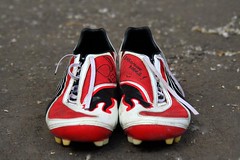
The next request was for better boots. Dawit showed me that the boots they had first bought were falling apart. This time I told the boys I would go with them to buy the boots. A few days later, Dawit called me to tell me they had found the type of boots they wanted. He told me he and one other of the boys would meet me at the corner grocery store to bring me back to the shop with them. When they arrived, we caught a taxi in order to get back downtown before the shops closed, my only taxi ride in Asmara, I think. The owner of the shop had set aside the boots in the right sizes. All I had to do was hand over the cash. The boys were all there to take the boots away. The owner thanked me not just for the cash, but also for helping the boys. 

Better boots meant more dirt came into the house with the boys. I decided to clean them one last time and then roll up all the area rugs and hide them away in one of the bedrooms. But the boots also had cleats so the boys realized they needed to take off their boots when they came in. There was quite a pile at the door each time they came over.

Dawit was a translator for me in other ways as well. For example, told me that the parents of the boys planned to invite me to the neighborhood so they could meet me. But then one day, I forget why, he was with me in one of the outbuildings behind my house. As we walked into the laundry room, he told me that most of the boys lived with their entire families in houses that weren't much larger than that room. And he then told me that although the adults wanted to meet me, they were uncomfortable inviting me to their homes because of how small they were.

Dawit also shared some of the same observations as the father who called me had. He told me that Habtom had in fact exagerated the cost of the pinnies. He also advised that I no longer give the boys money but instead buy what they need for them. Quite a wise young man was Dawit. Since he was giving me the same advice as the father, I asked if his father was the one who called me. He said the caller was not his father, but he didn't want to tell me whose father had called. So I remained in the dark for a little while longer.