Showing posts with label Iasi. Show all posts

Tuesday, July 2, 2013

Day 158 - The President's Coming To Town

Romania played an interesting role in the international arena during the time I lived there. It was part of the Warsaw Pact, placing it firmly in the red camp of nations, but President Ceauceșcu wasn't above playing his friends off against one another. In contrast to the Soviet Motherland which emphasized comradeship, commonality, the sameness of everyone, Ceauceșcu encouraged regional diversity among Romanians. There weren't just Romanians, there were Oltenians, Transilvanians, Muntenians, Walachians, Dobrogeans, Bucovinans, Moldovans, Maramureșean, Banațean, the regional groupings of Romanians with their distinctive traditional folk music, folk costumes, and village building styles, all of which could be seen in the Village Museum in Bucharest. Where in Moldova 15 years later, we saw all people in villages and walking along the highways all dressed the same, in Romania, the people outside the cities dressed in traditional clothing of the type that had been worn since Vlad Ţepeș resisted both the Turks and the Hungarians who traded opportunities to rule the geographic area that is now Romania. In Moldova those who had the means to ride on the highways were in cars, trucks, or on tractors while in Romania many still made their way between villages in wagons piled high with straw and pulled by horses or cattle.

Ceauceșcu was pleased to see his people differentiated from all his neighbors.

Politically, Ceauceșcu also sought opportunities to thumb his nose at his neighbors. He liked to be seen as making his own way in the world, not kowtowing to the Soviet Union or other larger nations. One example was his hosting, secretly, talks involving President Anwar Sadat of Egypt that led to Sadat's visit to Israel in late 1977. Those talks occurred in Bucharest early in my time in Romania, on a weekend when I traveled Thursday evening by train from Iasi to Bucharest.

Before I left Iași, my Fulbright researcher friend, Paul, asked how I had managed to get a ticket for that evening. He had gone that morning to buy a ticket, but he was told no one from the university was being allowed to travel that weekend. I must have purchased my ticket several days before, so I went to the train station Thursday evening and had no trouble getting a seat.

When I arrived in Bucharest that Friday morning, many of my friends expressed surprise that I had been able to get on the train. At the university in Bucharest, students weren't allowed to leave their dormitory buildings. No one knew why this was so, but there were, as was always the case in Romania, rumors. That weekend, my life went by quite normally. Most of my friends in Bucharest were connected to the embassy or the American School, and there were no restrictions placed on their movements. There may have been a few more Romanian policemen around the embassy, and they may have been a little more aggressive in demanding to see identification of people passing it on the street. But nothing really interfered.

When I returned to Iași, I learned that others had not been so lucky. In addition to my friend Paul not being able to buy a ticket on Thursday, the students in Iasi were also confined to their dormitories for the weekend. And we heard that one of the American Fulbright lecturers in Cluj-Napoca who wasn't able to get a plane or train ticket decided to drive to Bucharest for the weekend, but she was turned back on the highway. Still we had no knowledge of why.

Golda Meir and Anwar Sadat, www.aljazeera.com
When President Sadat finally did travel to Israel for that historic visit in November of 1977, the reason for the clamp down on the students in the country, especially the foreign students, was clear. Romania was one of the only countries in the world to have official representatives of both Israel and the Palestinian Liberation Organization in their capital city. Iran was another. There were large numbers of Arab students in Romania in all university cities. And there were Israeli students, including Israeli Arabs. Given the overwhelmingly negative reaction among the Arab world to President Sadat's visit to Israel, it was clear there were valid security concerns about what would happen in Romania if word got out about President Sadat's presence in Romania and the purpose for his visit.

Four years later, President Sadak was assassinated by one of his people. Eight years later again, Ceauceșcu met a similar fate, though without the same level of surprise.


Tuesday, June 25, 2013

Day 152 - The Students Who Never Came To Class

Some rights reserved (to share, to remix, to make commercial use of) by earthisthering http://creativecommons.org/licenses/by-sa/2.0/
empty classroom image by earthisthering, via Flickr.com
Another purpose for that big book in the English Department was to record grades of students. At the end of the first term, I learned that the members of each class would be listed in the book for the teachers to record their grades. Grades in Romanian universities ranged from 1 to 10 with 5 or higher passing.  Since my classes were Conversation or American Culture, the grades I gave were admittedly subjective. I didn't have tests or papers with grades to total up and average.

The first term, all of my classes were second-year English majors. The second term, only three of my classes were second-year English majors. One class was third-year French majors with English as their minor. And one class was a fourth-year elective course developing writing skills in English.

Three of those classes met in the evening. It was inevitable that some of the classes were held in the evenings, given the number of hours students spent in the classroom. It was challenging to get all the students to attend the evening classes. They followed a break of at least two hours, long enough for the students to get back to their dorm rooms or their apartments at the other end of town. Sometimes they just didn't make it back for that evening class.

The third-year French majors and English minors were one of those evening classes. Most evenings at least two of them showed up. Sometimes there were as many as five. Once none of them showed up, but I think that was one of the classes who heard I had gone to Bucharest.

It was very difficult to figure out what activities to plan for when it wasn't clear how many students would be in attendance. One of my favorite activities was something we also did in Iran called Dialog Cards. This exercise involved an ambiguous dialog written with only one half on each of two cards. The class would decide ahead of time if the dialog would be spoken by two men, two women, or a man and a woman. The class would decide which emotions the two speakers would put into their half of the conversation. The two speakers would look at one another while they spoke the words on their cards to one another, using the emotions the class had decided on.  The results were always hilarious. And the same cards could be used over and over again with different results just by switching the emotions and combination of speakers. But with only one pair of speakers, a class planned for this activity ended pretty quickly.

While I never saw them all at the same time, in all there were probably seven students in that class. I kept thinking about what I could have done during the term if they had all attended. So when the term ended and I opened up the big book to provide grades for those seven students, I was shocked to discover that there were 14 members of that class. Seven students came at least once. but seven more never showed up at all.

I gave them all 0's.

Within a week, one of those missing students came to the American/British reading library with a large bouquet of flowers and an explanation. She apologized for not attending any of my classes. She said she was married and had an infant. Once she got back to their apartment after her daytime classes, she had to take care of the baby and it was just too difficult to leave the baby behind for her to return to the university for the evening class. I asked her a number of other questions to get a better sense of her English ability. At the end of the conversation, I told her I would think about what she had told me and would consider changing her grade.

The next day, another of the missing students appeared outside the English Department and asked to talk with me. She said she had heard from her colleague that if she asked me, I would change her grade. I countered by explaining that her colleague had come to me, showing more courage than any of the other members of the class, that she had apologized to me for not showing me the courtesy of attending my classes, and that she had explained her reasons for not coming back to the university in the evening. Based on those factors, I had assured her that I would think about whether or not I would change her grade. I did not tell her I would change her grade. I told her I would consider it.

The following day, a third of the missing students appeared outside the English Department and told me she wanted me to change her grade. I was a bit surprised at the abruptness of the request so I told her I didn't have any reason to change her grade. Her counter to that was to tell me that if I didn't change her grade, she would have to retake the class in the summer and that meant that I would have to stay for the summer to teach the class again. I replied that whether she had to retake the class had nothing to do with whether I had to remain to teach it. But still she didn't give up. She said I had to change the grade because 0 wasn't a grade. So I replied, "And that is just what you got - no grade."

In the end, I changed the grade of the first student who came to explain and apologize, but I don't think I made it a passing grade. I didn't change the other grades. But I did add a note in the big book to explain why I had given the seven students who never came to my class a grade of 0. And I explained that I had been asked by some of the students to change that grade, but that I didn't feel I could in good conscience change grades of students who had never attended a class. But, since I didn't know all the implications of my decision, I would understand if someone on the faculty felt it necessary to change the grades in my place.

Sunday, June 23, 2013

Day 150 - March in Iași

Sample mărțișor
Sample mărțișor
By March, I had been in Romania for six months and had been living in the apartment on the plaza in the middle of town for two months. But I wasn't yet ready to say I was happy there. Life in Romania was much easier than life had been in Iran. It was as though everyone in Romania could sense when I had reached the point of wanting to walk away from a situation that had become too frustrating and then they would turn to me to ask what I needed. In Iran, I learned that when I reached that point, I had to patiently wait as long again unless I really did think walking away was necessary.

George, Sandra, and Ana in the park
But March first was the beginning of a change. According to the old calendar in Romania, March 1 was the beginning of the new year. Symbolically, observing March 1 centered around women and fertility. For this reason, my students all gave me mărțișor, small tokens or charms hung on twisted threads of red and white that are  pinned to clothing. It was a small gesture, but the first where I felt I was an individual, not the American lecturer.

The following week, March 8, was another holiday I hadn't known about, International Women's Day. On that occasion, one of my classes gave me a doll dressed in a folk costume of the region, Moldova.

Paul running to join us in the park
Paul running to join us
in the park
Those two events were the beginning of my feeling welcomed in Romania. And that made it possible for me to take actions to enjoy myself from that point on.

Sandra in front of  a statue in the park
Sandra in front of
a statue in the park
George in front of a statue in the park
George in front
of a statue in the
park
One example was an expedition that Paul, the American Fulbright researcher, two of my students, Ana and George, and I made to a park in Iași on an afternoon. The park featured a number of statues of historically important Romanians. We wandered through the park, taking turns posing in front of the statues in the same poses as the statues and taking photographs. It was an enjoyable afternoon with no purpose other than to enjoy the time.

 My impression was that students in Romania spent so much of their time and effort just getting through the day that there wasn't much time left just to enjoy life. I am happy that I had those small opportunities to enjoy Romania with my students.


Saturday, June 22, 2013

Day 149 - Genevieve

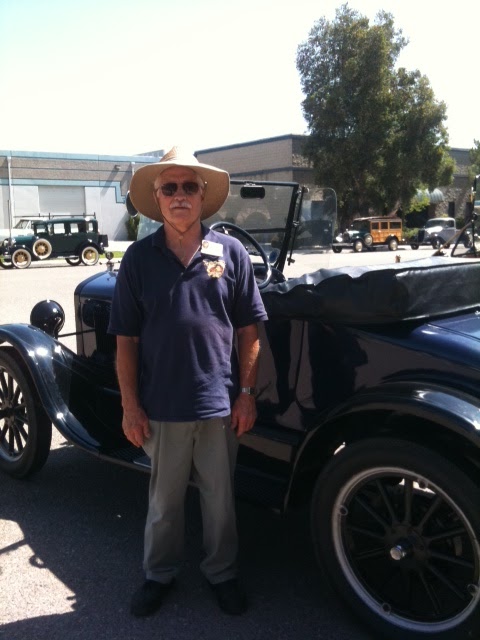
Row of Model Ts ready for instruction
The films we showed on Monday evenings were not normally ones seen in theaters anywhere in the world, with one exception: Genevieve, a 1953 British comedy that the British lecturer, Chris, got from the British embassy. The film involves two couples participating in the annual London to Brighton Veteran Car Run, not a race, but a drive in vehicles made during the veteran era which spanned the late 1880s to about 1904. Genevieve was one of the Veteran cars. a Darracq. The plot involves the competition between the two men which result in a number of tricks being played by one on the other. Most memorable to me was the result when the cancelation of their reservation in a posh hotel left Genevieve's owner and his wife having to check into a dingy local hotel. When Wendy, the car's owner's wife, discovers there was no running water in their room, she storms up the stairs, making it very clear that she is disgusted with how events are turning out. Her husband follows her upstairs rather sheepishly while one of the women behind the hotel counter asks the other, "Are they Americans?"

Even as early as 1953 we Americans apparently had a bad reputation overseas, even in a country where we shared a language.

This morning Alex and I got a taste of what driving Genevieve from London to Brighton was like. We were guests of the Histerical Auto Works of Santee, California, which offers an annual opportunity to learn how to drive Model Ts. This morning was this year's event.

Six owners of Model Ts brought their vehicles to the Histerical Auto Works and offered driving lessons. The cars were from 1912 through 1915. One was from all those years as it was built from donated parts.

Norm and his Model T
Norm was my instructor. Even before the lessons began, Norm was eager to show us all the distinctive features of his car compared to others. His was from one of the later years which was obvious, once Norm pointed it out, because the seat was lower than in earlier cars. Ford had moved the gas tank which in older models was under the seat to the front of the car. This was a strategic move by Ford because other cars with a lower profile were beginning to take a bite out of the car market. Norm pointed out that Gary's 1913 model with the gas tank under the seat and only one door must have been very inconvenient for any passenger because this model still had to be started with the hand crank which means either the passenger had to crank the car to life, or the passenger had to get out to allow the driver to do so. Since we had many opportunities to watch Gary crank start his car, we appreciated the amount of effort involved.

Norm's Model T had an ignition button on the floor in front of the driver's seat. All Model Ts continued to have cranks and could always be started using them, but later models didn't require cranking. For that I was very glad since I managed to stall the car several times during my lesson.

Sandra and Norm in Norm's Model T
Model Ts have two levers just behind the steering wheel, much like the turn signal and windshield wiper controls on a modern car, but their functions are quite different. The left lever is the spark lever which must be pressed before depressing the ignition button. The right lever controls the gas.  I could remember that until we approached an intersection where I had to make a right turn. Then I found my fingers heading automatically for the spark lever to signal my intention to turn.

There are three pedals on Model Ts. The right one is the brake. The middle one is reverse. And the left one is neutral, low, and high gear, depending on how deeply it is depressed. Norm described the gears as slow and slower. And then there is the lever that is part brake, part gears. I admit that I never did manage that one. Norm called is the brake at least once, but the right pedal is the brake. He kept moving the lever for me before I could accelerate, telling me it needed to be in the central position which I couldn't find - I only found two positions which never seemed to be the ones I needed.
Achievement Award Presented to Sandra Yeaman For Mastering The Technique of Driving a Model T Ford
My certificate, a bit of hyperbole
One thing I did learn is that if I needed to press a pedal, I needed to PRESS it. I kept hovering my foot over the brake, but then discovered my foot thought that pedal was the accelerator.  My feet wanted to do what my hands had to do and my hands wanted to do what couldn't be done.

I suggested to Norm that I might have learned as much as I needed to learn by that time. I was eager to get back to parking position which I knew meant that I was going to have to tackle the last pedal - reverse. It might have looked like a smooth landing to those on the sidewalk, but I was shaking inside as I backed up and then put on the brake.


Friday, June 21, 2013

Day 148 - Romanian Medicine

I told the members of the class that asked to remain with me about the theft of my soy sauce. I shared that I thought it would be funny to see the thieves' faces as they poured out and sipped what they thought would be some exotic liquer and instead got a mouth full of salt.  I had ordered the soy sauce from an international import company because it wasn't available in Romaia. My students told me there used to be soy sauce in the stores, but no one bought it because they didn't know how to cook with it. And that is when I invited them to have a Chinese meal for lunch one Tuesday. I not only had soy sauce, I also had oyster sauce. And with chicken and vegetables usually available, I was confident I could put together an acceptable Chinese meal.

Some rights reserved (to share, to remix, to make commercial use of) by NickPiggot http://creativecommons.org/licenses/by/2.0/
milk bottle image by NickPiggot,
via Flickr.com
The morning of the lunch, just as I was getting started with the preparations, there was a knock on my door. When I answered it, two of my students, Miriam* and Elena*, from that class were there. I asked why they had come so early and because they didn't answer my question, it appeared to me that they had forgotten my invitation. Instead, they asked if I had milk. Miriam had a calcium deficiency and she needed a quick dose. I had milk, but I apologized explaining that it was sour. Miriam said sour milk was better for her because her system absorbed calcium from sour milk more quickly than from fresh milk. Each day she would have to drink a quart of milk to get the calcium into her system. But since milk wasn't pasteurized in Romania, it was necessary to boil the milk for a fixed length of time and then cool it down. That morning, the milk she boiled separated into curds and whey and she didn't have time to boil more milk. So she headed to the university for her classes. While there, she realized she needed a calcium injection and got one at the student clinic. But it wasn't enough. She was on her way home with Elena accompanying her in case she had more problems when they they realized my apartment was at the plaza where they were waiting for a tram. And that is why they ended up at my door.

Miriam drank my sour milk, but even that wasn't enough. So they decided they needed to go to a hospital and there was one just behind the plaza. They asked me to go with them. I don't know if they thought a foreign lecturer as a companion would speed things up. But I was curious to know what the Romanian medical system was like, so I went with them.

My first observation was that I coudn't tell the doctors from the patients. I saw people walking down the hall wearing slippers and what looked like bathrobes. I assumed they were patients. But one of those slipper and bathrobe wearers showed up to examine Miriam in the room we were brought into to wait.

Some rights reserved (to share, to remix, to make commercial use of) by jbpic http://creativecommons.org/licenses/by-nc/2.0/
hospital ward image by jbpic, via Flickr.com
That "waiting" was my second observation: there didn't seem to be either a waiting area or examination rooms because the room in which we waited had six beds, each with a patient, and no chairs for us to sit in.

When the doctor examined Miriam, she started by tapping her left cheek. I watched as the muscles in Miriam's face rippled across her face and then rippled back. I had never seen anything like it. Apparently that satisfied the doctor that Miriam was short on the required amount of calcium, so she got another injection,

When we left the hospital, Miriam apologized about missing lunch at my house, but she felt she needed to go home and rest. Miriam then spoke very quickly with Elena which I interpreted to be instructions to get to the university to tell the other members of the class that the invitation for lumch was for Tuesday, not Thursday. The names of the two days are very different in Romanian, marti and joi, but much too similar in English.

I went back to preparing a Chinese meal. At noon, many of the members of the class arrived for lunch. One did give away that she got the message about lunch being that day very late.

They all said they enjoyed the meal. But I doubt they would have told me anything other.

*names, not necessarily the right ones

Tuesday, June 18, 2013

Day 146 - Cooking in Moldova

Some rights reserved (to share) by texascooking http://creativecommons.org/licenses/by-nc-nd/2.0/
lemon meringue pie image by texascooking, via Flickr.com
Cooking in Romania was a challenge in part because finding time to buy food was a challenge and in part because the range of what was available was limited. The shelves in the shops were full, but they were full of the same thing, not full of variety. For example, where in the U.S. the aisle with canned vegetables would have cans of all sizes and brands with corn, beans of all types, peas, asparagus, potatoes, palm hearts, tomatoes, peppers, and so on, in Romania a single shelf was full, top to bottom, left to right, of canned tomatoes - just canned tomatoes - in cans of the same size and brand.

The silver lining, of course, is that I could always find canned tomatoes.

Other items I could always get included chicken, lemon juice, sour cream, sugar, flour, a variety of soft cheeses, cabbage, onions, potatoes, cooking oil, eggs, and bread. That's about it. So I learned to take advantage of what was there.

For example, one of the types of cheeses I could always get was cașcaval, a moderately firm whitish cheese that was about the same consistency as mozzarella. And a common appetizer in the restaurants in Romania was cașcaval pane, or fried cheese. And I loved it. To prepare cașcaval pane, I needed an egg, a cup of flour, bread crumbs, cooking oil, and seasonings. With the egg, flour, and seasonings, I made a batter. After heating oil in a frying pan until it was hot, I dipped 1-inch thick slices of cheese into the batter, rolled the battered slices in breach crumbs to coat them, and then placed them in the hot oil to cook, turning each once to ensure even cooking.

I brought a variety of herbs with me which meant I had plenty of options for ensuring variety in my meals, in spite of the similarity - cașcaval pane with dill one day, with basil the next, with oregano the next, and so on.

I also brought The Joy of Cooking with me. While I could never find all the ingredients for any recipe, I could always get chicken so I worked my way through the poultry section of that cookbook, picking up whatever ingredients I could find and using what was available, mostly cabbage, onions, and canned tomatoes, as replacements for other ingredients.

Some rights reserved (to share, to remix) by kitsunebabe http://creativecommons.org/licenses/by-nc/2.0/
cheesecake image by kitsunebabe, via Flickr.com
But my special favorites were lemon meringue pie and cheesecake. While there weren't lemons in Romania, there were always bottles of lemon juice. Using the juice, along with the eggs, sugar, flour, and salt that were always available, I was able to mix up the crust and cook up the lemon mixture for the pie.

Cheesecake was more problematic. There was no Philadelphia cream cheese available. There also wasn't any ricotta or cottage cheese. But there were a number of different soft cheese as well as yogurt and sour cream. On weekends that I stayed in Iași, I tried different cheeses and combinations with yogurt or sour cream in a Joy of Cooking cheese cake recipe.

Once I moved to the apartment that had formerly been the French lecturer's home, I had a friend nearby to help me test my experiments, another Fulbrighter, Paul, who lived in one of the two hotels on the plaza where my apartment building was located.

Paul's hotel suite was larger than my apartment, although he didn't have a kitchen. So I could count on getting a positive reaction from Paul when I offered to bring over some cheesecake in exchange for an hour or two of watching TV in his suite.

Some rights reserved (to share, to remix) by Dallas Film Society Images http://creativecommons.org/licenses/by-nc/2.0/
function image by Dallas Film
Society Images, via Flickr.com
Because Paul's suite was so much larger, he agreed to host a cocktail party in honor of the International Visitor whose visit was arranged by the Cultural Affairs Officer of the American embassy when the IV came to Iași for his lecture.  It was my introduction to the world of diplomatic functions, events hosted by ambassadors or their staff to entertain and network with other diplomats and contacts within the local population, something I became much more familiar with in future years.

During the event at Paul's suite, I learned a trick from the Cultural Affairs Officer's wife. She would look around the room in order to find the oldest person in attendance. She would then approach that person and begin a conversation. After a few minutes, she would suggest that the two of them find a more comfortable place to continue their conversation, at which point she would lead the guest to a sofa so that they could both sit down. I liked that approach. As an introvert, I was never comfortable mixing at functions. I figured out how to start up a conversation, but I was never comfortable moving on to another conversation. That sometimes meant I managed to start up a conversation with another introvert in the room, someone as uncomfortable with making conversation as I was and equally uncomfortable moving on. Those conversations were painfully long. But Mrs. Cultural Affairs Officer's approach had two big advantages. First, the oldest person in the room usually had the most to say, often the most interesting content as well. And second, sitting down is a much more comfortable position to be in if the conversation turned out to be one of those long and painful ones.

Monday, June 17, 2013

Day 145 - English Language Social Club

Some rights reserved (to share) by thepodger http://creativecommons.org/licenses/by-nc-nd/2.0/
film image by thepodger, via Flickr.com
One of the advantages of having classes only on Tuesdays, Wednesdays, and Thursdays, was that I could travel to Bucharest each weekend to have time on Friday mornings to pick up books and films from the American Library in Bucharest for use the following week. The books I used in my classes. The films I brought back for the regular Monday evening film nights. The film nights had been going on for at least a couple of years before I got there. The American and British lecturers each had access to films from the cultural offices of our embassies. All we had to do was pick them up in Bucharest, let one of the Romanian staff members review the films to be sure they were deemed acceptable, and get them back to Bucharest later.

Having the films reviewed wasn't called censorship, but it was always amazing that the films I thought had the most interesting stories were deemed to be uninteresting by whoever reviewed them.

Most of the films I could get were in a series that had five segments of about five minutes each. The segments were about ordinary things, like county fairs, rodeos, restaurants. They were glimpses of life in the United States. They wouldn't have been exciting to an audience of American college students, but they were very popular with Romanian audience.

But most of the audience for film night were not our students. Instead, they were students in other disciplines where English was important - engineering and medicine, for example. And they were high school students and their English teachers. We were pleased to have a broader audience and started looking for other opportunities. Well, to be more accurate, my colleague Chris was eager to expand the exposure of English to our students and others. His idea was to set up an English Language Social Club one afternoon a week where the students could play board games, we would provide magazines and books for them to read, and offer opportunities for informal conversation. I was still too strongly influenced by the pessimism that two years of living in Iran had engendered in me. I was convinced it would take too much time and effort to accomplish Chris' idea. But Chris had been in Iasi the year before, so he had the details all worked out. All we needed was a room large enough for all those activities on Thursday afternoon, and permission from the English Department.

Chris managed to find a room in the same building where we showed films on Monday evenings, the Student Center. Thursday was the ideal day because it was the day most of the teachers had compulsory party meetings so there were no classes. Since our students had about 32 hours of classes every week, in contrast to the full-course load of 12-16 hours of American university students, finding a two-hour block when the majority of them would be free was a challenge. It also wasn't certain that our students would choose to spend two more hours with us since they had so few hours to themselves.

Some rights reserved (to share, to remix, to make commercial use of) by Mike_fleming http://creativecommons.org/licenses/by/2.0/
Monopoly image by Mike_fleming via Flickr.com
So we brought copies of Boggle, Scrabble, Monopoly as well as those magazines I had bought at Hornbachers and books from both the British and American embassies to the Student Center and waited to see if anyone would show up. They did. We set up the games throughout the room and helped each group get started with the games. I had expected the languages games, Boggle and Scrabble, to be popular, but after watching awhile, it was clear that those games didn't involve much conversation among the players. Monopoly on the other hand was a big hit. After we read the rules, the game began. The university had sent one of the Romanian instructors to the first session as our minder, we assumed, and we got him involved with the Monopoly game. He seemed to be the only player who seemed to think that playing the game just meant rolling dice and moving the tokens around the board. Buying property and demanding rent when a player landed on it seemed to be distractions to him.

Again, many of those who attended on Thursdays were students from other disciplines or high school students and their teachers. One week one of the high school students offered to show slides that her father had taken on a trip to New York. We were happy to give her the opportunity and fascinated at her presentation and the reaction. Her father had taken the usual picture of tall buildings and tourist sights, but those weren't the focus of her attention. Instead, she pointed out all those ordinary things - the traffic lights, the cars parked along the street, the length of the skirts the women walking on the sidewalk were wearing, the exhibits in the shop windows. And those in the audience asked her questions that she did an excellent job answering, given that she hadn't been in New York herself.


Friday, June 14, 2013

Day 142 - Returning from Paris

Iasi apartment in the industrial zone
I returned from Paris and Belgrade and found when I put the key into the lock, I didn't have to turn it. The door opened with the slightest bit of pressure because the left side of the door jamb was on the floor. It appeared that someone had kicked the door in while I was on my end-of-term holiday.

I looked around the apartment and was surprised that items of obvious value were still there: the TV that had never really worked and my combination radio, shortwave radio and cassette player. But there were things missing: a carton of cigarettes (of two) from the freezer, a carton of cigarettes (of two) from my underwear drawer, a bottle of scotch (of two) from my pantry cupboard, a bottle of gin (of two) from the same cupboard, and a very large bottle of soy sauce (of two) stored in the cupboard because they were too tall to fit in the kitchen cupboard.

After emptying my suitcases, I made my way to the university in order to report to Elena*, the foreign lecturer liaison for administration, that my apartment door needed to be repaired. After doing so, I went to the Department and mentioned to my colleagues that my apartment had been broken into. Then one of them mentioned that the same thing had happened the year before when my predecessor Michelle was the American lecturer. And another recalled that the same thing had happened two years before when Michelle's predecessor Harry was living in the apartment.

entertaining in my Iasi apartment in the industrial zone
There was a pattern. Every end-of-term break, the foreign lecturers left town. And every year for the past several years, the apartment I lived in had been the residence of the American lecturer.  I recalled the days before the end of term and I realized every evening for the week before I left, there had been a knock on my door sometime around 9 p.m.  Only one time was there someone at the door when I opened it, but he seemed to be looking for someone so after an exchange of a few Romanian words, he left. And then I remembered that a young man who lived in a nearby apartment had stopped by one evening to practice his English. He seemed very interested in the posters that I had hung on the walls in the living room.

I had never been keen on living so far away from the university. However, the embassy was very pleased that the university had provided such a large apartment for the American lecturer. It meant that a grantee with a family could be accommodated. They were opposed to my moving out of the apartment because they knew it would be unlikely the university would be able to provide such a large apartment as a replacement.

It wasn't just the distance from the university that disillusioned me about the apartment. It was on the 8th floor of a ten-story building. But the elevators frequently didn't work. Even when they worked, there was a problem with them. All elevators in Romania came to a gradual stop. The stops were so gradual that it was too easy to anticipate the stop and grab the door handle before it had reached a complete stop. The elevators stopped as soon as someone touched the door handle. The doors on Romanian elevators opened out. So anticipating the stop often meant getting stuck in the elevator until someone on another floor pressed the button to call it.

the kitchen in the Iasi apartment in the industrial zone
the kitchen in the Iasi apartment
in the industrial zone
And then there was the problem of water. The apartment was in the industrial zone. Industry requires water. That meant that the water was shut off in the middle of the day in residential apartment buildings in order to divert it to the factories. When the water was turned back on in the evenings, it often took several hours for the pressure to build up enough to reach the 8th floor. To mitigate this, I kept my bathtub full of water so I could flush the toilet with a bucket. I kept glass jars, pots and pans, and any other containers I could find full of water on every surface of the kitchen so that I could cook and wash up afterwards.

So it was ironic that when the university crew came to repair the door, I was in the tub when I heard a knock on the door. I ignored it, figuring that whoever was knocking would go away. I was more than surprised when I heard the door open and two men walked in. I grabbed a towel (a mighty skimpy Romanian towel) and wrapped it around as much of me as it would cover and I started yelling at them as I walked down the hallway toward the entrance of the apartment. The two guys turned around pretty quickly and high tailed it out of the apartment.

And then I started to worry. I still needed the door repaired, but I had just made it clear to the guys who showed up that I wouldn't let them in. If this had happened in Iran, I would never get those guys back to do the work. But by the time I got back to the university to tell Elena what had happened, she had already heard and apologized for not making a phone call ahead of time to let me know the workmen were coming.

I really didn't want to stay in that apartment, but I had to be patient. Within a week or so, I learned that the German lecturer wasn't coming back to Iași. Her apartment was some distance from the university which was appealing to the French lecturer whose apartment was downtown right on the tram line which meant it was noisy. The French lecturer asked to move to the German lecturer's apartment, and I asked to move into the French lecturer's apartment. Where the French lecturer preferred the solitude of being far from town, I preferred to be in the middle of the activity. The embassy agreed that the end-of-term break-in, for at least the third year in a row, was a compelling case for my move.

The downtown apartment was much smaller - one bedroom instead of two (or maybe it was three). The kitchen was half the size. There was no pantry cupboard. And there was only one electrical outlet in each room - and none in the bathroom. But it was within walking distance of the university, a big plus. It was also on a plaza with two hotels, each with restaurants, and a food market. There was a movie theater across the street with both the Tarom airlines office and the train station a quick jog away.

Life got just a little bit easier after my move.

*a name, not necessarily the right one

Thursday, June 13, 2013

Day 141 - French Words

Some rights reserved (to share, to remix, to make commercial use of) by wlappe http://creativecommons.org/licenses/by/2.0/
image of Eiffel Tower by wlappe, via Flickr
One similarity between the university system in Romania and in the U.S. was that there was a break between sessions around the end of the calendar year. It wasn't referred to as a Christmas break, just the end of term. And there wasn't much incentive for me to stick around in either Iasi or even Bucharest, so I made plans to travel to Paris and Yugoslavia. I had friends living in both places, a strong incentive for picking them as destinations.

When I mentioned to the French lecturers that I planned to travel to Paris, one of them, Lionel*, suggested I practice my French with him before I went. I told him I didn't speak French. He looked at me sideways and paused thoughtfully, after which he said, "But surely you speak French words." After giving it some thought, I realized he was right. My French repertoire consisted at least of the following words and phrases.

Conversational Phrases
  • Bonjour. (Good day.)
  • Bonne nuit. (Good night.)
  • Au revoir. (Until we meet again.)
  • Tres bien. (Very good)
  • Adieu. (Farewell)
  • Comment allez-vous? comment ça va? (How are you?)
  • Merci beaucoup. (Thanks very much.)
Clothing and Cosmetics
  • beret (hat)
  • chemise (blouse)
  • pantalon (pants)
  • jaquette (jacket)
  • haute couture (high fashion)
  • parfum (perfume)
Food
  • pain (bread)
  • gâteau (cake)
  • biscuit (cookie)
  • chocolat (chocolate)
  • orange (orange)
  • limon (lemon)
  • coq au vin (chicken in wine)
  • pâtisserie (pastry)
  • quiche (quiche)
Adjectives
  • petit (small)
  • grand (big)
  • blanc (white)
  • rouge (red)
  • noir (black)
  • bleu (blue)
  • beige (beige)
  • violet (violet, purple)
  • brun (brown)
Phrases
  • Voulez-vous coucher avec moi ce soir? (Oh, come on now, don't try to tell me you don't know what this means.)
  • chassez les femmes (chase the women)
  • influence d'argent (influence of money)
Then Lionel pointed out the additional French words that I knew, perhaps without realizing I knew them, because they are also Romanian, Spanish, or English words, borrowed from French.
  • cadeau (cadou in Romanian, gift)
  • hier (ieri in Romanian, yesterday)
  • the names of the days of the week
And suddenly the light went on. I could speak French. With Lionel's encouragement, I added a few more words and phrases:
  • Parlez-vous anglais? (Do you speak English?)
  • Je suis désolé, je ne parle pas français. (I'm sorry. I don't speak French.)
  • Vouz avez [fill in the blank]? (Do you have [fill in the blank]?)
  • Je veux [fill in the blank]. (I want [fill in the blank].)
Paris store Some rights reserved (to share) by KiRin Chen http://creativecommons.org/licenses/by-nc-nd/2.0/Armed with overconfidence, I decided I could travel to Paris and make my way around with ease. I made plans, contacted my friends Shellagh and Bill who I met in Tehran before Bill was transferred to Paris by his employer, IBM. Shellagh told me how to get from the airport to an area near her office where she met me and showed me how to get to their apartment by metro and bus. After a quick lunch, Shellagh went back to work and I set out to explore.

Using my French words and phrases, I managed to accomplish the following all in that first afternoon: I brought a pair of boots to an atelier de réparations de chaussure to arrange to have the heel that snapped off as I got off the bus in Iași at the train station replaced, I brought a film to a boutique de photo to turn in a film to be developed, I made an appointment at a salon de coiffeur to have my hair cut, and I found a boutique that advertised l'anglais est parlé ici so that I knew I had an excellent opportunity to make myself understood as I looked for new clothes.  I returned to Bill and Shellagh's apartment that evening with a new dress, a black velvet pant suit, as well as the hair appointment and arrangements to pick up my repaired boots and developed prints the next day.

The rest of my stay in Paris, I toured the normal places: the Eiffel Tower, the Louvre, Montmarte, Sacré-Coeur, Notre-Dame, Champs-Elysées, Centre Georges Pompidou. I took photos. I spent hours in front of artwork in museums, reading the titles to figure out more about the French language. It was helpful that most paintings had descriptive names, not just Untitled.  Riding the metro and buses offered more language learning opportunities. I got pretty good at figuring out the meaning. I still had trouble speaking and understanding when others spoke.

After Christmas, I flew from Paris to Belgrad, Yugoslavia, where I caught a bus to travel to Novi Sad, the capital of the autonomous region of Voivodina which is entirely surrounded by Serbia. A friend from San Francisco State University, George, had been at the university there for more than two years as a Fulbright lecturer. My roommate Annie and I had previously visited him from Iran on our trip at the end of our first year in Tehran. George invited me to join him at a New Years' Eve party with his colleagues and some of their students. I thought I could try out some of what I had learned about speaking French words while in Yugoslavia. After all, I had studied Russian at Concordia, so I thought I could make some sense out of Serbian through its similarity to Russian. Serbian uses the same Cyrillic alphabet as Russian, and I had had that earlier trip to Voivodina to build on. So imagine my surprise when one morning while listening to the radio, I heard the announcer say, "Ora este ora unsprezece," Romanian for "The time is now 11 o'clock."

That put thoughts of trying to learn more about Serbian and get back to Romania to concentrate on that language.

*a name, not necessarily the right one

Monday, June 10, 2013

Day 139 - Shopping

I have always enjoyed shopping. Even in Iran I enjoyed shopping, at least once I learned never to try to buy more than one item on my shopping list per day. The trick in Iran was to go in search of just one item and then to stop either a) the item was found and purchased, at which point it was time to celebrate, or b) it started to get frustrating, at which point it was time to stop and celebrate not falling over the emotion cliff.

But shopping in Romania took special skills and patience.

Some rights reserved (to share, to remix, to make commercial use of) by MACSwriter http://creativecommons.org/licenses/by-sa/2.0/
Cheese by MACSwriter, via Flickr
One of the teachers, Viorel*, who lived near my apartment in the Industrial zone took me around to the nearby shops and pointed out some of the items that he thought were the best on offer. He pointed out the importance of always carrying a pungă or plastic bag because one never knew when one might find something to purchase. Literally. I never knew. Years later, in Moldova, I met the chief of police in Chișinău whose name was Col. Pungă. Since we had just lived the previous three years in Barbados where calypso was king, I couldn't help comparing the Colonel's name with one of the kings of calypso, Red Plastic Bag. But I digress.

There weren't supermarkets in Iași. Even in the markets that looked something like grocery stores, many items were not out on shelves where they could be handled and put into a basket while wandering down the aisles. Eggs were behind one counter. Butter and cheese behind another. Salami and sausages behind another. And purchasing anything behind the counter meant lining up first to tell the clerk which and how many of each you wanted. The clerk would then hand over a scrap of paper with something written on it which was to be taken over to the person behind the cash register where waiting in line to pay was required. Then once payment had been made, the receipt on yet another scrap of paper had to be handed back to the person behind the first counter who would then hand over the purchases.

Shopping for groceries could take a long time. And since the university was at the other end of town from the industrial zone, I often had to leave for classes too early for any shopping in the morning and then I returned after my classes, many of which were in the evening, too late to do shopping in the evening. If there hadn't been Casă Universitarilor or University House, which served meals during the lunch hour, I wouldn't have been able to eat at all. My first meal there, however, was a disappointment because I ordered ciorbă de burtă. I was told that ciorbă was a hot spicy soup, and sometimes it was, but ciorbă really just means soup. And de burtă means of tripe.

The shopping I really looked forward to was shopping for craft items, not food. Each city of any size had at least one shop that specialized in artsy crafty things. In Iași, that shop was in the center of the city, along the tramway between the industrial zone and the university. I think I even had to change trams there, but I rarely had enough time to go checking out the items in the store. And that's when I learned how important the advice to carry a pungă at all times was because it also went along with the advice to buy whatever you see that you like when you see it because it won't likely be there if you wait. I can recall seeing some lovely embroidered items - probably a table cloth and napkins - from the window of the tram. But I didn't get out and check them out. The next day, they were gone.

Another challenge when shopping for items displayed in the window is that the clerks in the stores were very reluctant to take them out of the window if someone wanted to buy them. Items on display were apparently just for that - display - to get customers into the shop, but not to be sold. I recall others telling stories of going into shops to buy books that were clearly visible behind the counter, but the clerks would insist there were none available. I guess all those behind the counter may have been special orders and I suppose it just might have been that we foreigners didn't understand Romanian well enough to figure out explanations about special orders, but it is also equally believable that the clerks didn't think we foreigners needed to know more than they told us - there were no such books available. Period.

One day I found a box in the grocery store that was labeled shrimp cakes in English. The box also had text in Chinese and probably Vietnamese. I concluded those were the other two languages on the box because the box declared in English that the contents were packed in Vietnam. The year was 1977 so seeing items from Vietnam wasn't something I expected back it the U.S. I couldn't tell from the feel of the box just what shrimp cakes were. I imagined an interior tray with compartments to hold six soft cakes. I bought a box. When I got back to my apartment, I learned from the directions that the cakes should be fried in hot oil. When I opened the box, instead of six cakes held in a divided interior tray, I found a plastic bag full of what looked like poker chips. They were white, red, orange, and yellow. And they were as hard as poker chips. After heating oil in a frying pan, I dropped about a dozen of the chips into the hot oil and discovered they all puffed up to about 4 or 5 times their original size. They had a consistency a lot like rice krispie bars, but without the melted marshmallows to hold them together. Once I realized that putting more than two or three into the pan at a time was a bad idea, I cooked up a few and ate them like popcorn.

Remember now, the instructions for these were in English, Chinese, and Vietnamese, not Romanian or even French.

The next time I took the train to Bucharest, I discovered vendors walking along beside the passenger cars offering smaller bags of these shrimp cakes for sale as a snack for travelers. Each bag appeared to have about a dozen shrimp cakes in them - but these cakes hadn't been cooked. They were still their original poker chip size and texture. I wonder how many people broke teeth when trying to eat them.

A friend, Margaret*, told me of another example of imported goods that weren't selling well. This time the items were on display in a Parfumerie where toiletries such as soaps, perfumes and cosmetics were sold. In this case the boxes on display were a pastel color and had butterflies printed on the outside. Again, the description was in English, not Romania or French. When Margaret read the box, she realized it contained contraceptives - condoms - so she bought a box just for the novelty of it. Romania had an austere program to encourage population growth through forbidding the use of contraceptives. After Margaret put a box into her shopping basket, a Romanian woman approached her and asked quietly what was in the box. Margaret explained to the best of her ability in Romanian that the contents of the box prevented babies. The Romanian woman shared this news with the other women in the store and within minutes the display was empty.

Some rights reserved (to share, to remix, to make commercial use of) by La.Catholique http://creativecommons.org/licenses/by/2.0/
beer by La.Catholique, via Flickr
My biggest shopping challenge was when I decided to invite a few of the other foreign lecturers to my house for an evening of socializing. There was a British lecturer, a Polish lecturer, and two French lecturers in town. I decided I should have beer on hand. But when I got to the store, I learned that in order to buy bottled beer - the only kind there was - it was necessary to bring in an empty bottle for each full bottle of beer I wanted. The bottles had to be brown bottles, not the clear ones that mineral water came in. After I explained that I didn't have any empty beer bottles, the clerk agreed to sell me two bottles of beer. These were not big bottles. These were more like the size that 7-Up and Coca Cola came in back in the days when the 8 ounce bottles of Pepsi were the biggest soft drink bargain in town.

The only other brown bottles I had seen in the market held cooking oil. In desperation, I bought four bottles of cooking oil in brown bottles, took them home and dumped the oil down the drain. I had to soak the bottles in hot soapy water to get both the labels off and the slickness from the oily contents out of the inside. With those four empty bottles, I was able to purchase another four bottles of beer. I think I settled for wine for the rest of the beverage offerings.

*a name, not necessarily the right one

Sunday, June 9, 2013

Day 138 - Arriving in Iași

Alexandru Ioan Cuza University, Iași, Romania, by blankdots via Flickr
Alexandru Ioan Cuza University, Iași, Romania,
by blankdots via Flickr 
I arrived in Iași, often spelled Jassy in English texts, by train and was met by Eugene*, one of the teachers in the English Department of Alexandru Ioan Cuza University, probably the foreign instructor minder (responsible for keeping tabs on us, not for protecting us) for the University. After driving me through town when he pointed out a single building as "the university," Eugene brought me to my apartment on the 8th floor of a building in the industrial zone. Now the university building he pointed to was impressive, but I was used to a university consisting of multiple buildings located on a campus, so I probably didn't react with appropriate awe in response. And I probably also didn't react with appropriate awe to the apartment. It had two bedrooms, a luxury by Romanian standards, and the living room had a TV, the kitchen had a refrigerator, and there was quite a large storage cupboard, all of which were beyond the reach of many Romanians. But I didn't know that yet.

What I did know was that I was very thirsty, but I didn't want to drink tap water. I asked my escort if he could get some mineral water for me before I tried to get some sleep before he planned to return to pick me up in the afternoon to get checked in with the university administration. I knew that drinking tap water would invite digestive problems since I had learned that my system rejected tap water in Minnesota if it hadn't first been boiled and then refrigerated since my system had adjusted to tap water in Iran. Eugene returned a few minutes later with several bottles of mineral water. After opening one bottle and taking a big swallow, I realized why those providing our orientation in Bucharest had mentioned that Borsec brand mineral water was the best. The water Eugene brought was not Borsec and it tasted much more like minerals than water. And it smelled like sulfur.
Legitimaţie

That afternoon Eugene returned and brought me to the university where I turned over my passport and an appropriate number of photographs so that I could get my legitimaţie or official identification card. I also saw the English Department office for the first time. It was a very large room with tables lining three sides with chairs behind them. None of the instructors had their own offices; the English Department office was for all the instructors.

There was always one instructor on duty in the Department. The responsibilities of the person on duty was to answer the telephone - there was only one telephone for the Department - and to write notes for others in the ledger. Other instructors would always check the ledger when they arrived, to see if there were messages for them.

The Department had a small library of books, most of which had been left behind by previous British or American lecturers. I had been given a small amount of money, I think $100, to buy English language materials to bring with me. Since I wasn't able to attend the orientation the summer before my arrival, I wasn't quite sure what materials I was supposed to bring; the guidelines were pretty general. So I bought one copy of every magazine in the rack at Hornbachers with a little money left over that I decided I would figure out how to spend once I arrived in Romania.

My schedule included 5 classes with 15 students in each. Since American music had been very popular in our classes in Iran, I decided I would play a piece of music that I thought was clever for my classes on our first meeting. I knew that listening to music was challenging in one way - it is not always easy to figure out the words from a song - but in other ways music made learning language easier. Think of all the nursery rhymes and stories set to song that we learned in kindergarten and still haven't forgotten.  Sing along with me: I'm a little teapot, short and stout. . .

The song I picked was "Put Another Log On the Fire"** sung by Waylon Jennings. I was pretty sure the students wouldn't have heard the song before, and because of the ironic humor in the second verse, I thought I would be able to see on their faces whether they really understood the words. And I knew I had to have handouts with the words on them to satisfy their curiosity after playing the song.

And that meant - I thought - that I had to have 75 copies, one for each of the 15 students in the 5 classes. But there were no photocopiers in Romania. There were no ditto machines in Romania. And while there were mimeograph machines in the country, they were closely controlled by the government or its institutions, such as the universities, so getting a paper copied meant filling out a form, providing an explanation that someone in the hierarchy would accept, and then waiting three weeks for the work to be done. My alternative was to line up five pieces of paper with carbon paper between them and type the lyrics 15 times - very slowly so that I wouldn't make any mistakes that would be difficult to correct.

My first class all expressed interest in listening to music for their American culture class. I played the song on my 1977 version of a boom box, a very heavy combination radio, short-wave radio and cassette tape player. There was no electric outlet in the room, so I was lucky I had batteries in it. I watched the students' faces and there wasn't a flicker of recognition of the irony at the end of the second verse. When the song ended, I asked they they enjoyed it. They all said they did. I asked if they understood the words. They all said they did. I asked if they would like to hear it again. They all said they would. But this time I asked if they would like to see the words while they listened. They all agreed they would. So I handed out the lyrics and watched as the students began reading them. Before I was able to rewind the cassette and press Play, they had all finished reading and now they were all laughing.

I played the song again. And then we had a discussion in English about what the song meant.

At the end of the class, as the students began leaving the room, they all came up to the desk to return the lyrics. I was stunned that they didn't realize they could keep them. And they were stunned that I was giving them something to keep.

I never typed 75 copies of a handout again.

*a name, not necessarily the right one

**Put Another Log On the Fire

(Shel Silverstein)
Waylon Jennings & Tompall Glaser

Put another log on the fire,
Cook me up some bacon and some beans,
And go out to the car and change the tire,
Wash my socks and sew my old blue jeans.

Come on baby you can fill my pipe and then go fetch my slippers,
And boil me up another pot of tea,
Then put another log on the fire babe,
And come and tell me why you're leaving me.

Now don't I let you wash the car on Sunday,
And don't I warn you when you're gettin' fat,
Ain't I a gonna take you fishin' with me someday,
Well, a man can't love a woman more than that.

Ain't I always nice to your kid sister,
Don't I take her driving every night,
So sit here at my feet cause I like you when you're sweet,
And you know it ain't feminine to fight.

So put another log on the fire...